
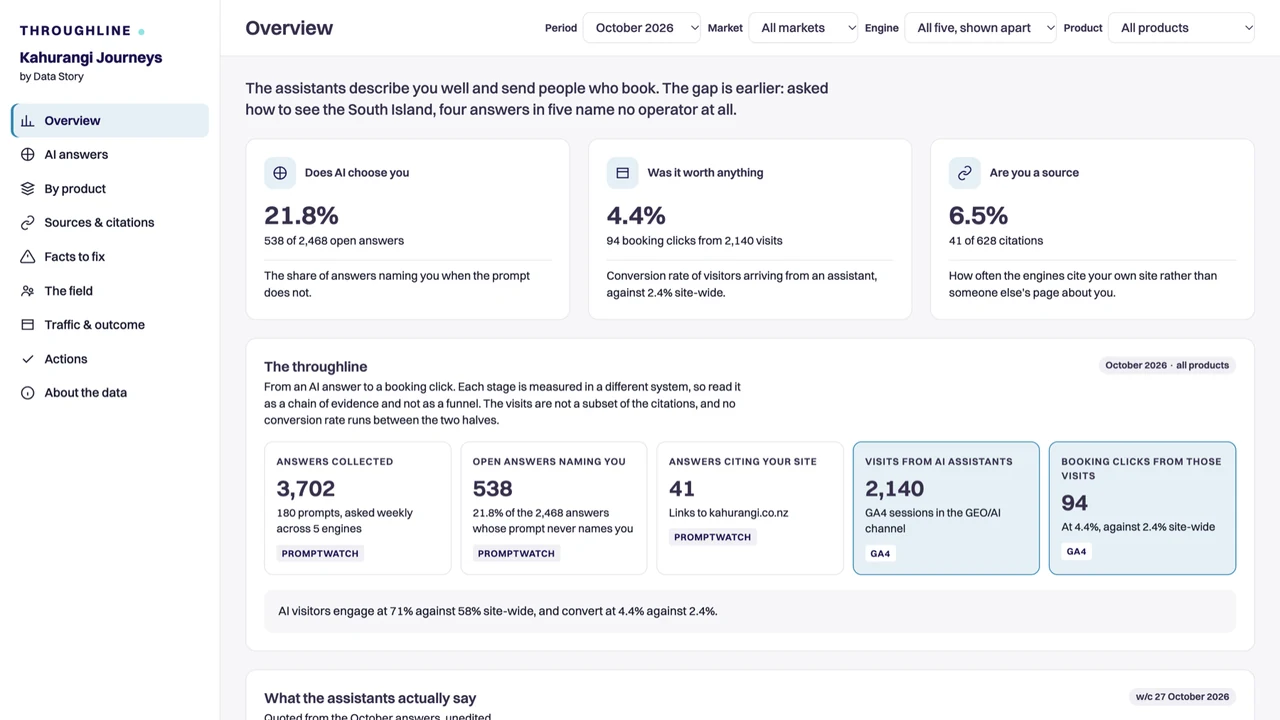
There's no shortage of tools promising to measure your visibility in AI search. They'll tell you how often ChatGPT recommends your brand, which competitors appear alongside you, and how frequently AI engines cite your website.
But we're still learning how to interpret the data these tools produce.
At Data Story, we've been analysing AI-generated answers across our clients to understand how AI engines recommend brands, choose sources and respond to different questions.
Our latest analysis covers 150,421 answers across 19 PromptWatch projects, collected between August and November 2026.
We also tested findings from other AI search researchers, against our own data.
Here are six things we learned, and what they mean for businesses investing in AI search.
1. Your prompt library needs to be bigger than you think
If you're measuring AI visibility using a handful of prompts, your results could be seriously misleading.
We tested this by taking different samples of prompts for the same brand during the same week.
With just 10 prompts, the brand's visibility could appear anywhere from approximately 30% to 90%.
That's a huge difference, without necessarily reflecting any real change in how often AI recommends the brand.
When we increased the sample from 10 to 100 prompts, the standard deviation fell by 68%.
That's almost exactly what sampling theory predicts. More prompts reduce the influence of individual answers on your overall visibility score.
For brands that aren't appearing consistently, small samples can make visibility look much more volatile than it really is.
The lesson isn't that every business needs exactly 100 prompts. It's that you need enough relevant prompts to produce a reliable measure, and to understand how much variation is normal.
The takeaway: Make sure your prompt library is large enough and representative of the questions your customers actually ask.
2. Being recommended is slow equity. Being cited is a faster-moving opportunity.
One of the most important things we discovered is that AI engines behave very differently when deciding who to recommend versus which websites to cite.
The brands they recommend are remarkably stable. The sources they cite change constantly.
Across 18 projects, we tracked the brands each project was monitoring, including the client and its competitors, over four to seven weekly collection runs.
The median proportion of tracked brands appearing in only one run was 0%. In our projects, not a single tracked brand appeared in just one week and then disappeared.
But when we looked at the websites cited in those same answers, we found the opposite pattern.
51% of cited domains appeared in just one weekly run.
Even when we excluded one-off citations and looked only at domains cited at least three times, source domains showed approximately three times as much churn as tracked brands.
That tells us something important about how to approach AI search.
Getting recommended is the long game
AI engines appear to maintain relatively stable sets of brands they associate with particular topics.
If your business is consistently recommended, that's a valuable position to protect.
If you're missing from the recommendations, publishing a few new pages is unlikely to transform your position overnight.
Building those associations requires sustained work: strengthening your brand's connection to the categories, experiences and customer needs you want to be known for.
It behaves more like building brand equity than improving a search ranking.
Getting cited is the more immediate opportunity
The websites AI engines use to support their answers are much less stable.
They're regularly drawing on different sources, even when the brands being recommended stay the same.
That creates an opportunity for businesses to get their content cited without first having to change which brands the engine recommends.
You're not necessarily trying to displace a permanent incumbent. You're competing to become one of the sources selected as the engine generates answers.
There are exceptions. Some highly authoritative websites appear consistently across collection runs. But much of the citation landscape is fluid.
That changes how we measure success
A brand appearing consistently in AI recommendations is a meaningful indicator of its position within the tracked category.
A single citation, on the other hand, tells us very little.
If your website gets cited this week and not next week, that doesn't necessarily mean your GEO strategy is working or failing.
We need to look at citation patterns over time, rather than celebrating individual wins or reacting to individual losses.
The takeaway: Treat brand recommendations as a long-term strategic measure, and citations as a shorter-term opportunity to improve your content's presence in AI answers. Measure and invest in them differently.
3. Some websites are much harder to compete with than others
Across our tourism clients, one pattern repeatedly emerged: large, authoritative tourism websites dominated AI citations.
On many topics, these websites accounted for the majority of citations. On weaker topic clusters, they were sometimes almost the only sources being cited.
That's a challenge for smaller destinations and tourism operators trying to improve their own visibility.
Imagine you're looking at your AI search report and discover that your website receives very few citations for hiking experiences.
The obvious response might be to improve your hiking content so you can outrank the websites currently being cited.
But what if the dominant source is a national tourism authority?
It's not another regional operator competing on equal terms. It's an established website with extensive content, significant authority and a strong position in travel information.
Simply rebuilding a regional hiking page is unlikely to be enough to displace that advantage.
So the objective needs to change.
Rather than trying to replace the national tourism authority as the primary source, a more realistic goal may be to become a consistently cited regional source alongside it.
That could mean improving the specificity of regional information, providing detail the national website doesn't cover, and strengthening the relevance of individual pages to particular traveller questions.
It's a useful reminder that not all citation competitors are equal.
The takeaway: Understand who's dominating citations before deciding what you're realistically trying to win.
4. If a topic matters, give it its own page
One of the clearest patterns we've seen is that AI engines frequently cite pages that closely match the specific question being asked.
A dedicated page about a topic is a stronger candidate for that question than a page that mentions the topic in one paragraph.
We can see this on our own website. On questions about generative engine optimisation, AI engines cite our dedicated GEO service page sixteen times as often as our homepage, even though the homepage talks about GEO too.
We found a similar pattern when analysing AI citations for a tourism client.
Of the citations to their website, almost two-thirds went to story and editorial pages, rather than the main category pages.
Think about the difference between a general page and a dedicated article answering a specific traveller question.
The general page helps visitors explore what's available. The editorial page gives AI engines a more direct answer to the question being asked.
That distinction matters. AI engines aren't simply looking for authoritative websites. They're looking for pages with information relevant to the question.
This doesn't mean every possible search deserves a new page, or that dedicated pages automatically win. But it does suggest that content architecture matters.
If a topic is commercially important, it needs enough focused, accessible information for AI engines to recognise the page as a useful source.
The takeaway: If a topic matters to your business, make sure you have a page that answers it directly.
5. Being recognised by AI isn't the same as being recommended
This might be the most commercially important finding in the analysis.
We measured two different types of AI search prompts for a tourism client.
Aided prompts explicitly named the destination, such as 'best [product] in [destination]'.
Unaided prompts described what the traveller wanted at a national level, such as 'best [product] in New Zealand'.
The results were dramatically different.
- 38.6% visibility when the prompt named the destination.
- 4.3% visibility when it didn't.
That's a 34.3-percentage-point gap.
When someone asks about a specific product or experience, they've already decided it's relevant. The AI engine's job is to provide information about it.
But when someone asks where to go or what to do on their holiday, the product or experience has to earn its place in the recommendation.
That's where you compete for consideration before the traveller has made a decision, and what you should be measuring in isolation.
The takeaway: Measure whether AI recommends you when customers haven't already mentioned your brand or destination. That's where you can identify opportunities to grow consideration.
6. How and where you measure AI search changes your results
Our final finding concerns the measurement process itself.
We compared daily and weekly collection patterns across three projects.
At weekly spacing, the number of distinct domains cited increased by 33–50%, while the brands being recommended barely changed.
This suggests that looking at citations across a wider period can reveal a broader set of sources, even when the underlying brand recommendations remain relatively consistent.
We also found substantial differences between AI engines.
- Microsoft Copilot had the most stable citation set, with 35% of domains appearing in only one run.
- Claude was at the other end, with 70% of cited domains appearing in only one run.
- Gemini, Google AI Mode and AI Overviews, ChatGPT, and Perplexity fell between those extremes.
That doesn't mean one engine is better than another.
It means the same citation metric can behave very differently depending on which engine you're measuring.
It also means a single aggregate visibility score can hide important differences in performance and normal variation.
Collection frequency matters too, although comparisons need to control for the number of observations before we can isolate the effect of spacing alone.
The takeaway: Keep your measurement methodology consistent, and understand how results differ by AI engine before interpreting changes.
What does this mean for your AI search strategy?
There are two distinct jobs in GEO measurement.
The first is making sure you're measuring AI search reliably.
You need a sufficiently large and representative prompt library, a consistent collection methodology, and a clear distinction between brand recommendations and website citations.
Otherwise, you risk making decisions based on noise.
The second is understanding why your visibility looks the way it does.
A regional tourism organisation struggling to compete with an authoritative national website for citations needs a different strategy from an operator whose important topics lack dedicated pages.
A product that AI recognises when named, but rarely recommends unprompted, has a different challenge again.
And a business whose products are regularly recommended without the operator being named may need to focus on brand attribution rather than simply generating more product mentions.
These problems can all look like 'low AI visibility' in a dashboard.
But they don't have the same cause, and they shouldn't have the same solution.
The most valuable thing AI search measurement can tell you isn't just how visible you are. It's what's preventing you from being more visible, and what you can realistically do about it.
That's what we're working to understand at Data Story, and it's the thinking behind how we measure AI visibility.
What's stopping you being more visible in AI search?
Two businesses can show the same visibility score for completely different reasons: one is losing citations to a national website, another lacks the dedicated pages AI engines want to cite, a third is recommended constantly without ever being named as the operator.
We measure AI search against the questions that matter to your business, work out which of these problems you actually have, and connect the answer to the numbers you already use to run your marketing.
See how we do itRather talk it through first? Book a call. Want to keep up as the ground shifts? Get our newsletter.

Written by
Hannah Stuart
Head of Strategy
Hannah leads strategy at Data Story, working with clients to turn marketing data into growth roadmaps. She brings deep experience in full-funnel digital strategy, attribution modelling, and performance marketing across New Zealand and Australian markets.
LinkedInRelated articles
SEO & GEO
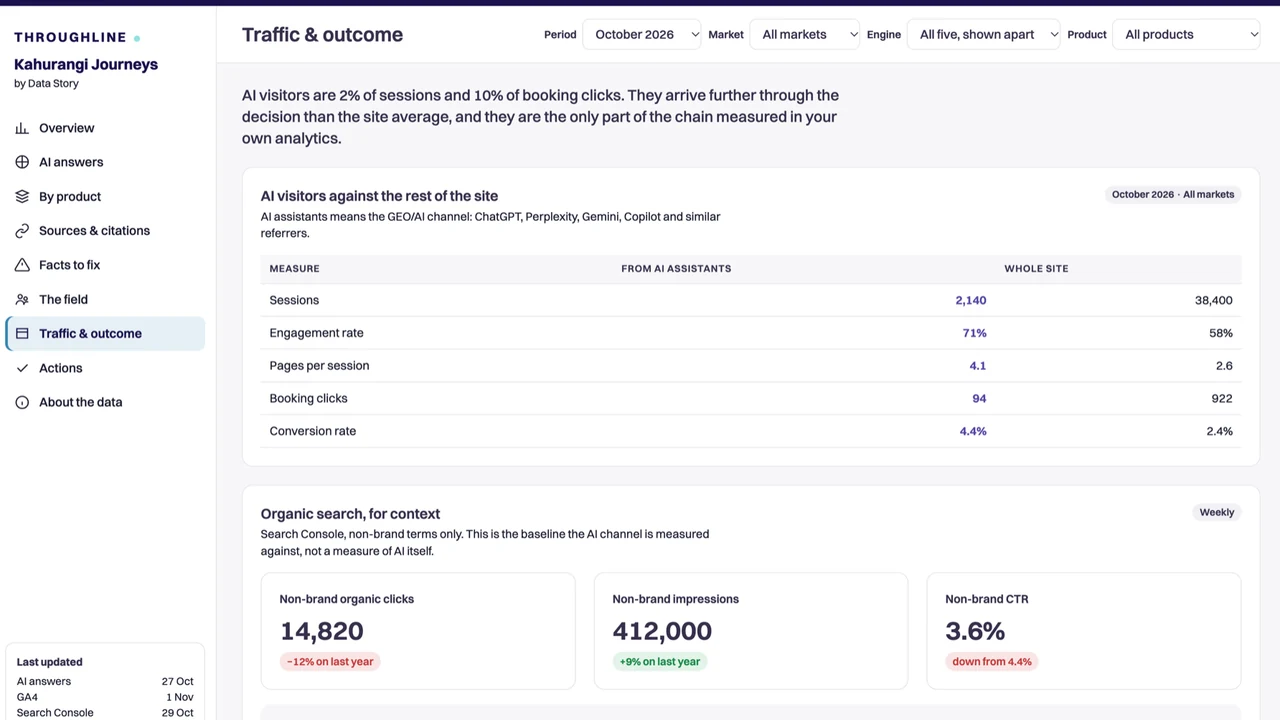
Organic traffic is falling. So why aren't bookings?
2 November 2026
Organic search clicks are disappearing while bookings and revenue hold steady. What tracking 2,700 AI search prompts a week across 16 brands is teaching us about where customers now make their decisions.
Read article
SEO & GEO
How destinations can improve performance using category search SEO
28 September 2026
Category search happens when a traveller knows the kind of trip they want but has not chosen where to take it. We show which pages reach these undecided searchers and how to build them.
Read article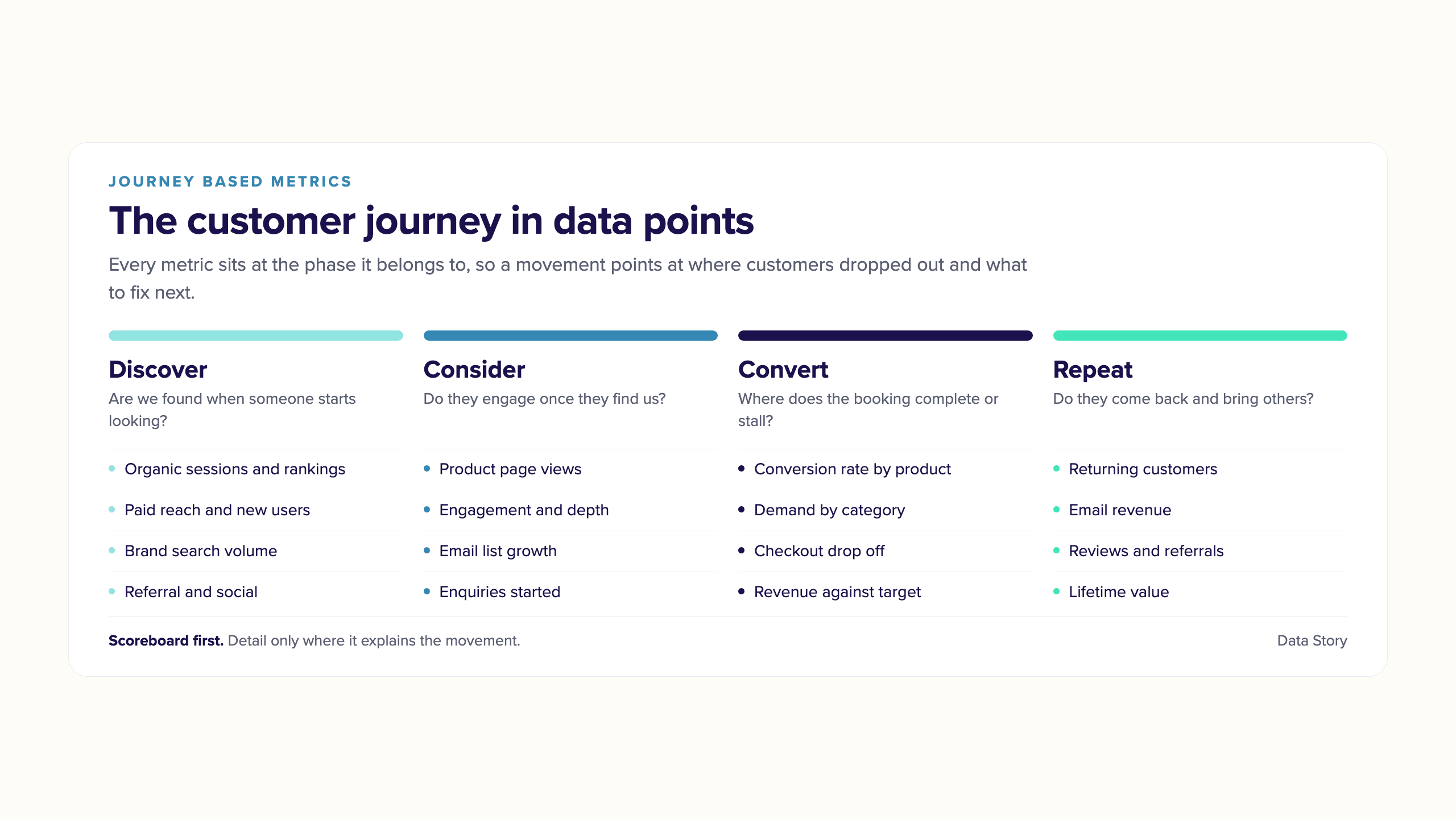
Analytics
Journey Based Metrics
11 August 2026
One client describes our reporting as her customer journey in data points, showing where growth sits and where customers drop out of the booking process. Here is what that gives a marketing team that board reporting cannot.
Read article