
Something interesting has been happening in our clients' data this year.
Organic search traffic is falling. In some cases, quite significantly. But when we look at the numbers that actually matter to those businesses, we're not seeing the same decline.
Bookings are holding up. Revenue is holding up. And in some cases, conversion rates are improving.
Traditionally, a drop in organic traffic would have been a pretty clear signal that something needed fixing. More SEO, better rankings, more content.
But what if the traffic isn't disappearing because people have stopped looking for what you offer?
What if they're just finding their answers somewhere else?
Thankfully, we track how AI assistants answer the questions that matter to our clients, so we can see more of the search everywhere picture than a traffic report shows.
Following the missing clicks
Think about how you might plan a holiday.
A couple of years ago, you might have searched Google for the best things to do in Queenstown, opened five or six websites, compared your options, and eventually made a booking.
Today, you might ask ChatGPT to plan your trip. You get a shortlist, compare a few recommendations, and only visit a website when you're ready to look at prices or book.
The research still happens. The customer still spends money. But several of those website visits never happen.
We can see patterns consistent with this shift in the data.
Across the businesses we're measuring, organic traffic is down.
At the same time, branded search and direct traffic are becoming more important, and the organic visitors who do arrive are often more likely to convert.
That doesn't prove AI is responsible for every missing click. Google's own search features are changing too, and there are other factors at play.
But it does suggest that using traffic as our primary measure of search performance is becoming increasingly misleading.
And it raises a more interesting question.
If people are making decisions before they reach your website, how do you know whether your business is part of that decision?
So we started looking at the answers
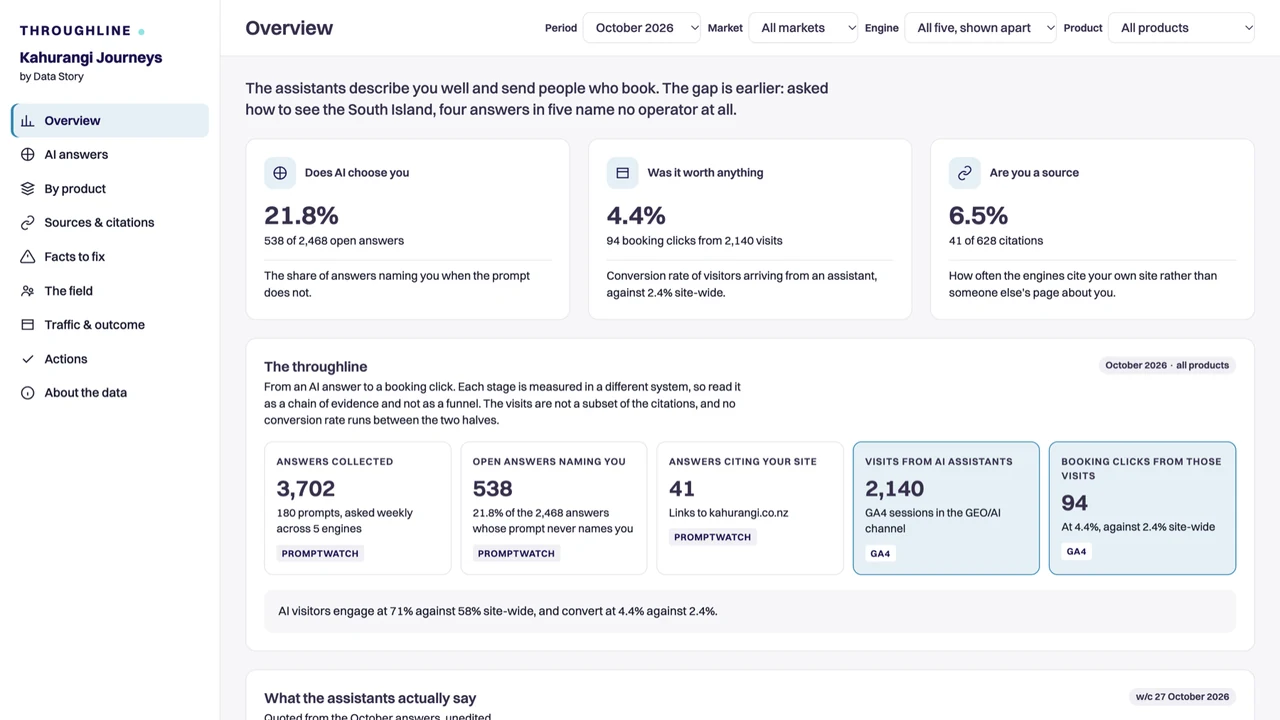
In September & October, we tracked how AI assistants respond to the questions that matter to our clients.
We're now testing around 2,700 prompts every week, across 16 brands and seven AI engines. Since August, we've collected more than 150,000 answers.
We could have started by tracking how often each client's brand appeared in AI answers. That's relatively straightforward to measure.
But we weren't convinced it would tell us much about whether their marketing was working.
So we started somewhere else: with the questions each business was already trying to answer.
For some, that meant understanding who gets credit for their products. For others, it meant understanding which markets offered the greatest opportunity, or whether customers were considering their category at all.
Then we worked backwards to decide what we needed to measure in AI search.
Take a tour operator.
One of its best-known experiences might be recommended regularly by AI assistants. At first glance, that looks like a win.
But what happens if the assistant recommends the experience without mentioning who runs it?
Or recommends booking through a reseller instead?
The experience has won the customer's attention, but the operator hasn't necessarily won the booking.
That's a very different problem from simply not appearing in AI search.
It's also a problem the operator can put a number on. Every booking is either direct or through a trade partner, and the commission on each sale is already in the accounts.
For another client, the question might be whether AI recommends the right destination. For a health information service, it's whether the answer is accurate and cites the official source.
Different businesses, different questions, different consequences.
Which is why we've become increasingly sceptical of treating AI visibility as a single score.
The people who do click are surprisingly valuable
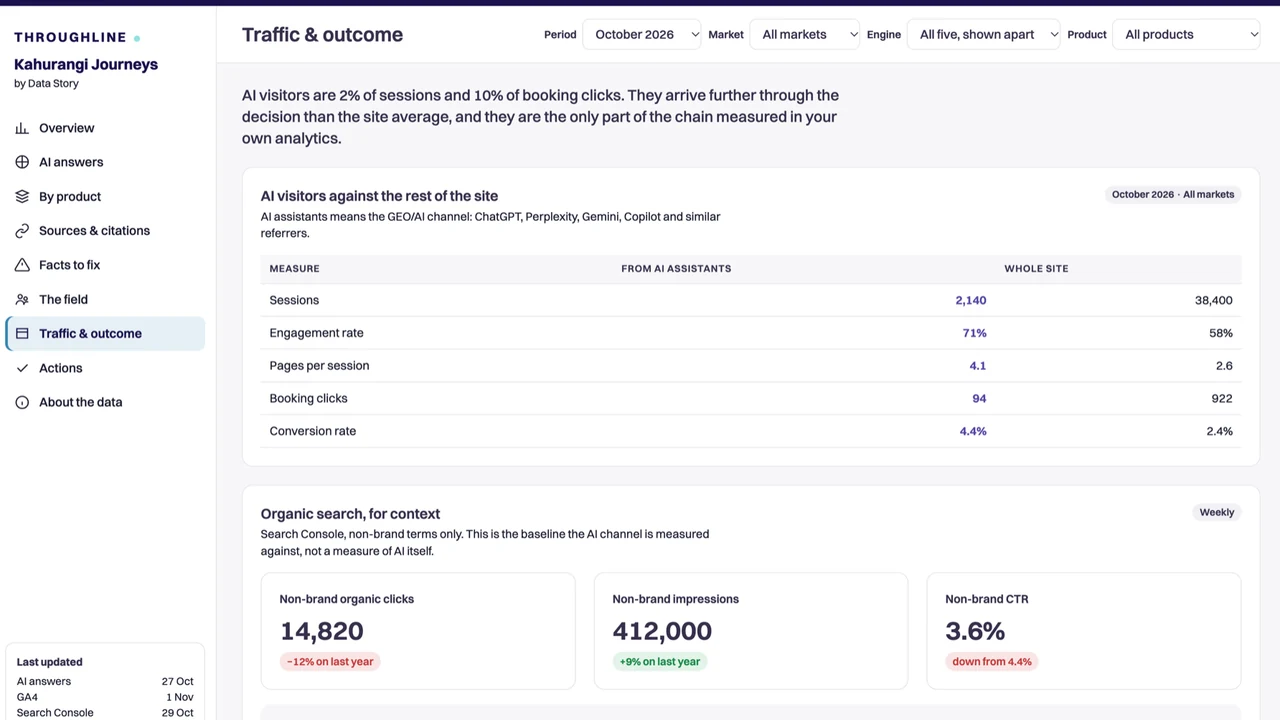
One of our clearest findings has been the quality of traffic coming from AI assistants.
At 14 of the 16 brands we're measuring, visitors referred by AI tools convert at a higher rate than the site's average.
Across the eleven brands with sufficient traffic to make a more meaningful comparison, the median conversion rate is 1.32 times the site average.
That sounds promising, but there are two important catches: AI referral traffic is still tiny, and for most of these brands the conversion we can measure is a booking click or an enquiry rather than a completed sale.
It accounts for less than 1% of sessions at almost every site we measure, and around 95% of those referrals come from ChatGPT.
So we're not about to suggest that AI referrals are replacing organic search traffic. They aren't, at least not in the numbers we can directly attribute.
What is interesting is that referral volumes at some operators have grown two to four times compared with last year, without an obvious deterioration in conversion quality.
People arriving from AI assistants often appear to be further along in their decision-making.
They've already asked questions, compared options and narrowed down what they want. By the time they reach a website, they may have a much clearer reason for being there.
We're seeing a similar pattern in traditional organic search. Even where sessions are declining, purchases from those sessions are holding steady or increasing.
The remaining clicks appear to be more valuable.
For marketers, that's a significant change. We've spent years trying to grow the number of people arriving on a website. Now we need to pay much closer attention to what those people are arriving to do.
Being recommended isn't the same as being chosen
This is where our research has become particularly interesting.
We've been looking at the difference between questions people ask when they're exploring options and questions they ask when they're closer to booking.
And the answers change.
On unbranded questions, operators that own a specific product tend to become much more prominent as the customer gets closer to making a purchase.
In our dataset, those operators become far more prominent at the booking end than at discovery.
Across the booking-stage answers we've collected, it is usually another operator's domain that appears, with review platforms and online travel agents close behind.
If you run a tourism business, that should make you curious.
When someone asks an AI assistant where to book an experience you provide, who does it recommend?
Your website? A reseller? A competitor?
And if the customer books through someone else, what does that mean for your margin?
That's a much more useful conversation than whether your brand visibility has gone up by five percentage points.
It's also why we're starting to think about AI search less as a new traffic channel and more as another place where customers form preferences and make decisions.
The commercial opportunity isn't always getting more mentions. Sometimes it's making sure the right business gets the credit, the recommendation and ultimately the booking.
What does this mean for your marketing?
We're still early in understanding how AI search will affect customer behaviour, and there are plenty of things we can't yet measure confidently.
But one thing is becoming clear: we need to rethink how we measure the value of search.
For years, organic traffic has been one of the headline measures of SEO performance. More visibility meant more clicks, and more clicks generally meant more opportunities to convert.
That relationship is changing.
If your organic traffic is falling but bookings and revenue are holding steady, the answer isn't necessarily to chase the missing clicks.
And if your AI visibility is increasing, that doesn't necessarily mean you're winning more customers.
The question is what you actually need AI search to do for your business.
Do you need more people to discover your category? More people to consider your product? More customers to book directly rather than through a reseller?
Each of those is a different commercial problem. And each requires different measurement.
Which brings us to something we've become increasingly convinced of through this work.
The most important part of AI search measurement happens before you open a dashboard.
It's deciding what you need to know, why it matters, and what you'll do differently when you have the answer.
Is AI recommending you, or someone else?
Somewhere in an AI answer right now, a customer is choosing between you, a reseller and a competitor, and no traffic report will show you how that choice went.
We track the questions that matter to your business across the AI engines your customers use, and join what the answers say to the numbers you already measure: bookings, enquiries, direct versus trade, revenue by market. The starting point is never a score. It's what you need AI search to do for your business.
See how we do itRather talk it through first? Book a call. Want to keep up as the ground shifts? Get our newsletter.

Written by
Hannah Stuart
Head of Strategy
Hannah leads strategy at Data Story, working with clients to turn marketing data into growth roadmaps. She brings deep experience in full-funnel digital strategy, attribution modelling, and performance marketing across New Zealand and Australian markets.
LinkedInRelated articles
SEO & GEO
We analysed 150,421 AI answers. Here's what we learned about AI search.
2 November 2026
Six findings from 150,421 AI answers across 19 tracking projects: why small prompt libraries mislead, why brands are stable but citations churn, and what that means for your GEO strategy.
Read article
SEO & GEO
How destinations can improve performance using category search SEO
28 September 2026
Category search happens when a traveller knows the kind of trip they want but has not chosen where to take it. We show which pages reach these undecided searchers and how to build them.
Read article
SEO & GEO
We have built a custom solution to the biggest challenge in destination marketing right now - AI Search Visibility
22 July 2026
See what AI tools say about your destination or experience today, then improve it. Our custom solution makes your visibility in AI search measurable across the customer journey, then gives you a plan to improve it.
Read article