
A dashboard isn't a strategy.
AI search is changing how customers discover and choose businesses. But knowing how often your brand appears is only useful if you know what to do with that information.
What does an AI visibility score actually tell you?
An AI visibility score tells you how often an AI assistant names your brand. It does not tell you whether being named was worth anything. AI visibility measurement becomes useful at the point it is joined to a decision the business is already trying to make.
There are plenty of tools that can tell you how visible your brand is in AI search.
They’ll give you a score, show you which competitors appear alongside you, and tell you whether your visibility has gone up or down. And that’s useful, to a point.
But what happens next?
If your visibility increases by 10%, what does that actually mean for your business? Are more customers considering you? Are they booking directly? Are you reaching the markets you want to grow?
If you can’t answer those questions, you’ve got more data. Not necessarily more insight.
At Data Story, we think measurement should start somewhere else.
With the decisions you’re trying to make.
Why does a GEO product measure the same thing for every business?
It was designed before it met you
A GEO product decides what to count before anyone looks at your business. Every client gets the same measures, because that is what makes it a product.
It measures what everyone has in common
Sold to every business, it can only report what every business shares: a visibility score, a mention rate, a competitor list. Your commercial question is not on that list.
The metric becomes the target
Once a figure appears on a dashboard it turns into something you are expected to improve. Visibility is down, so we need to increase it. Nobody asks what moving it is worth.
It cannot tell you what to ignore
Every figure on it is presented as worth watching. A product that told you half its own contents were irrelevant to your business would be a strange thing to build.
None of that makes the tools bad. It makes them general. The difference is whether anyone asked your questions before deciding what to measure, and a product bought off a shelf cannot have done.
Does Data Story hold itself to the same standard?
We build dashboards and offer GEO services. But the value isn’t in the dashboard itself. It’s in whether the measurement helps our clients make better decisions.
What happens when AI measurement starts with a business question?
We recently worked through this with a New Zealand tourism operator. Rather than beginning with a generic AI visibility report, we looked at the commercial questions the business was already trying to answer.
Which international markets represented the greatest opportunity, and how much of the demand in each was arriving directly rather than through OTAs and other resellers? Was the business building consideration for the type of experience it offered, or only for its own brand? And who was it actually competing against for a place on a traveller’s shortlist?
Those questions gave us a much more useful starting point. Here are three examples of what we found.
Does AI visibility match the markets the business wants to grow?
The operator sells into several international markets and its commercial priorities differ in each one. AI recommendations varied considerably between them. In our testing, the category appeared in:
79%
of eligible answers in the home market
55%
in a second market
40%
in a third market
That’s a significant difference. But the interesting question isn’t simply why visibility is lower in one market. It’s whether that reflects a genuine opportunity, the way customers in that market book, or the role of OTAs and trade partners who already own the relationship there.
By comparing the AI answers with bookings, commission paid and channel mix by market, we can start to understand whether the business needs more awareness, stronger direct distribution, or a different approach altogether.
Is AI search building demand for the category?
Sometimes the challenge isn’t getting customers to choose your brand. It’s getting them to consider the type of experience you offer in the first place. We tested what happens when someone asks an open-ended question about how to travel around New Zealand, without mentioning the product or category.
65%
of eligible answers recommended the category
That gives us a starting point for understanding whether the category enters consideration while people are still exploring their options. We can then look at that alongside non-branded search demand and the wider brand positioning work.
Because improving brand visibility won’t necessarily help if customers aren’t considering the category in the first place.
Who is the business competing against in AI answers?
A business might know exactly who its traditional competitors are. But when someone asks an AI assistant for the best experiences of a particular kind anywhere in the world, the competitive set can look quite different. The sample here is small, so read it as a prompt for a question rather than a finding.
1 in 5
international recommendation answers didn't mention New Zealand at all
It raises a strategic question. Is the business competing primarily with other New Zealand operators, or with international experiences for a place on someone’s holiday shortlist?
The answer could influence where the business invests its marketing budget and how it positions the experience in different markets. And that’s a more useful question than asking whether its AI visibility score is improving.
What do these AI visibility findings not prove?
We’ve measured what AI assistants are saying. We haven’t proved what those answers are doing to customer behaviour.
What these findings do not show
- If visibility is lower in one market, that does not automatically mean the business should spend more there.
- If a category appears more often, that does not necessarily mean demand is growing.
- If a country is absent from an international answer, that does not mean a traveller ruled it out.
These are findings that help us form hypotheses, not conclusions we can jump straight to.
The next step is to compare them with the commercial data the business already has, understand what’s actually driving each pattern, and only then decide what to change.
A dashboard is quicker to read and better looking. This is the version that connects AI visibility to the commercial outcomes you already report on.
Connecting measurement to the decisions a business is actually making is the work we call Data for Strategy.
Explore Data for Strategy →What order should marketing measurement run in?
Diagnosing before you act decides what you are trying to find out. The measurement is the instrument you reach for once that is settled. They run in this order, and swapping the first two is the mistake this page is about.
- What decision are we trying to make? This decides what is worth measuring at all, and what to stop collecting.
- Where in the buying journey are we losing people? Every measure tagged to a stage, so the reporting shows which stage leaks.
- Why is that stage leaking? The deep dive that works out the cause before anyone builds anything.
- What do we do about it? Execution, then the same measure re-read next month to show whether it moved.
How do you audit your own reporting in fifteen minutes?
You don’t need a new tool to do this. You need about fifteen minutes and last month’s report.
Most reports lose more than half their rows at step two. That isn’t a failure of the reporting. It’s the point of the exercise.
- 1
Write down three decisions you're actually trying to make. Real ones, with money attached.
- 2
List what you currently measure, and mark which of those three decisions each figure informs.
- 3
Only then ask what AI visibility data would help answer the questions still open.
What does measurement built this way look like?
Measurement built around a decision leads with the decision. The AI answer data and the commercial data sit on one page, and every figure names the system it came from.
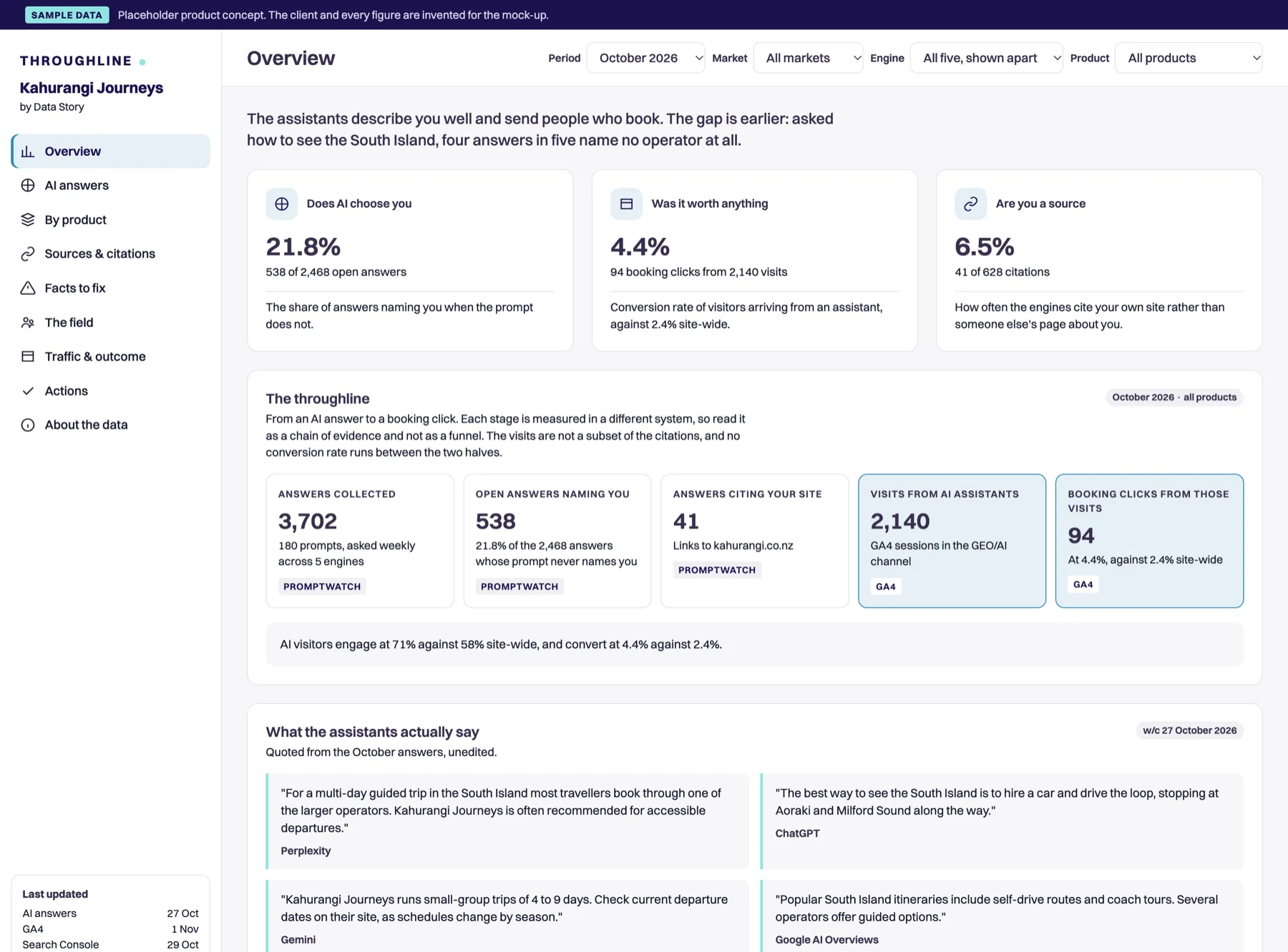
Shown on a sample account with invented figures. The chain runs from an AI answer through to a booking click. The last two steps are marked out because they come from the client’s own analytics rather than from the AI answers, and no conversion rate is drawn across that join.
Frequently asked questions
Where the diagnosis came before the build



Start with the business question.
Working out the commercial questions your measurement should answer takes a session. What comes out of it is a measurement plan, not a tool.