Kāpiti Coast District Council
The council that runs its own AI-visibility loop
Generative Engine Optimisation
July 2026
More and more residents ask an AI assistant before they ask the council. Kāpiti Coast District Council wanted to see what those assistants tell residents, and improve it. Data Story gave them a way to measure and improve what AI says, and the council now runs that loop in-house.
A practice the council can run itself
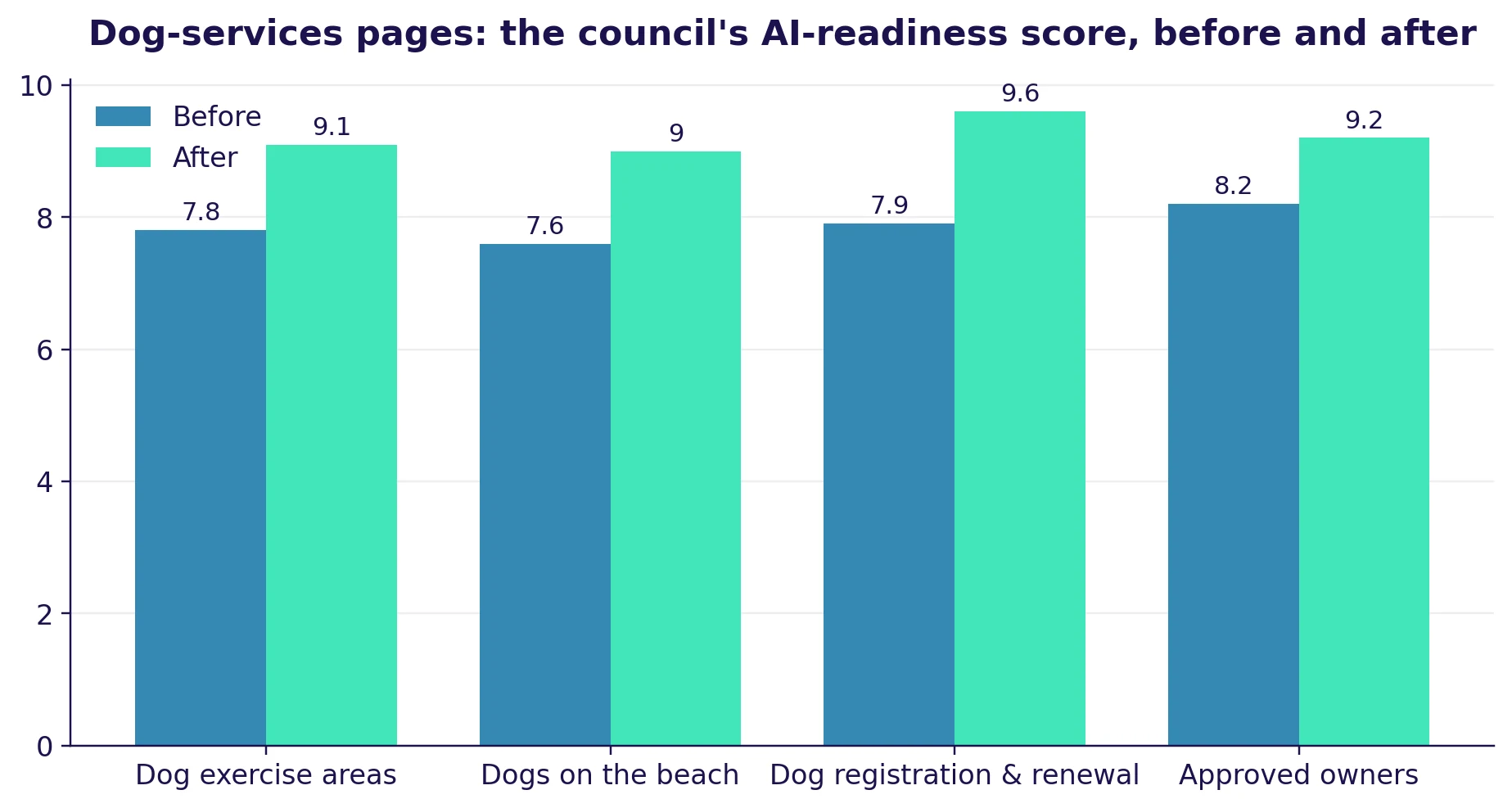
7.9 → 9.2
The council's own AI-readiness score for its first cluster of high-traffic pages, out of 10
In-house
The council now runs its own measure-and-improve loop, across several AI assistants
Every page
In that first cluster improved on the council's rubric
A method the council can run itself, not a report that ages the moment the models change.
The council couldn't see what AI was telling its residents
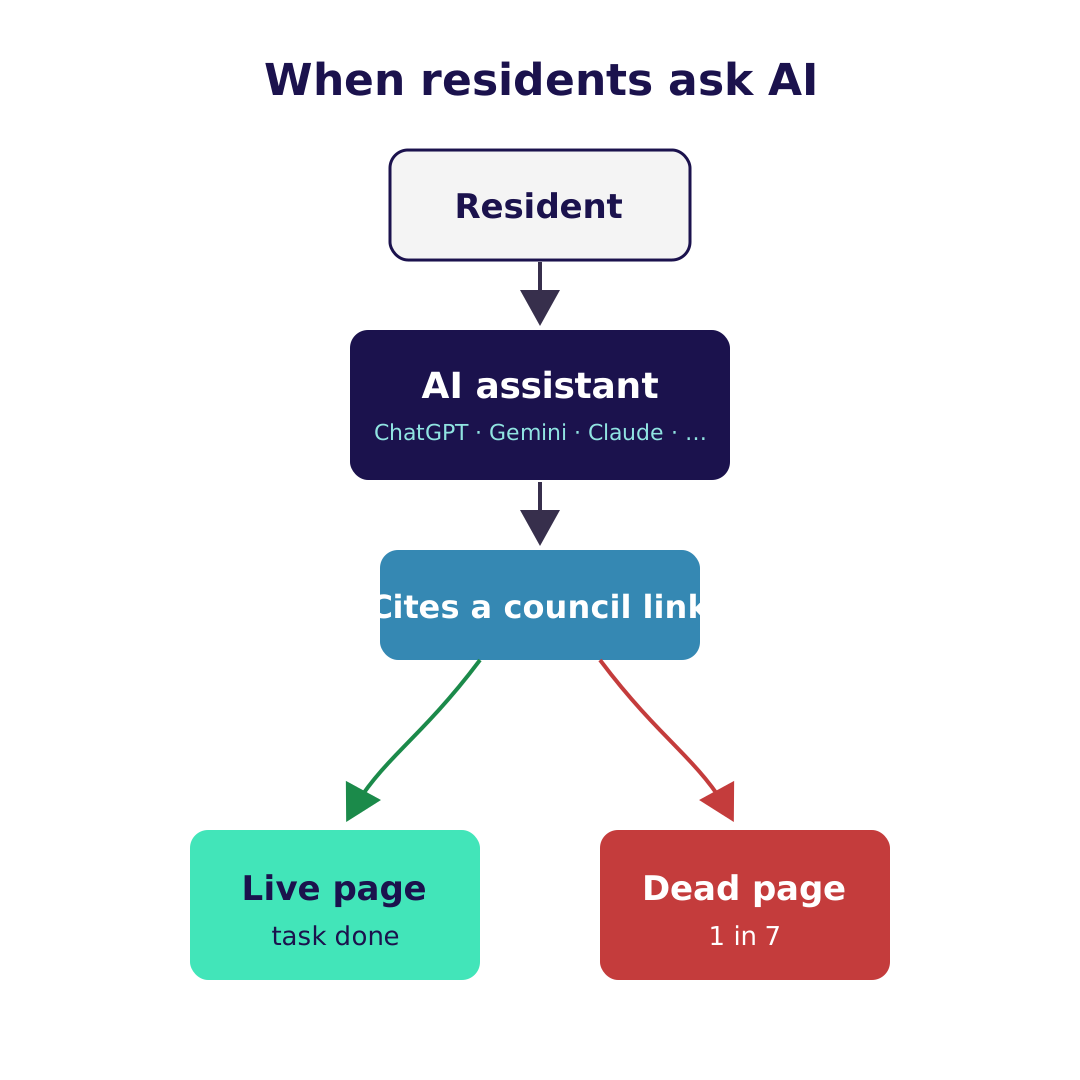
"How do I pay my rates?" "Can I take my dog to Raumati Beach?" "Is my property at risk of flooding?" The assistant's answer has quietly become a new front door to council services, and it is one the council cannot see and does not control.
That is a hard problem for a council specifically. The highest-volume resident questions are transactional and often time-sensitive, and some are safety-related. If an assistant sends someone to the wrong page, an out-of-date form, or a page that no longer exists, a resident cannot finish a civic task, or worse, acts on wrong information. None of it shows up in the council's own analytics, because the exchange happens inside the assistant, not on the council website. Without a way to measure it, the council had no baseline and no view of which pages the engines pointed to.
Transfer the method, not a report
Data Story treated this as a measurement problem first, and a capability problem second. Most agencies would run an audit and hand over a report. A report goes out of date as soon as the AI models change, which leaves the council no better able to keep up. So we gave the council a method it could run itself, so it can keep improving pages without needing us back.
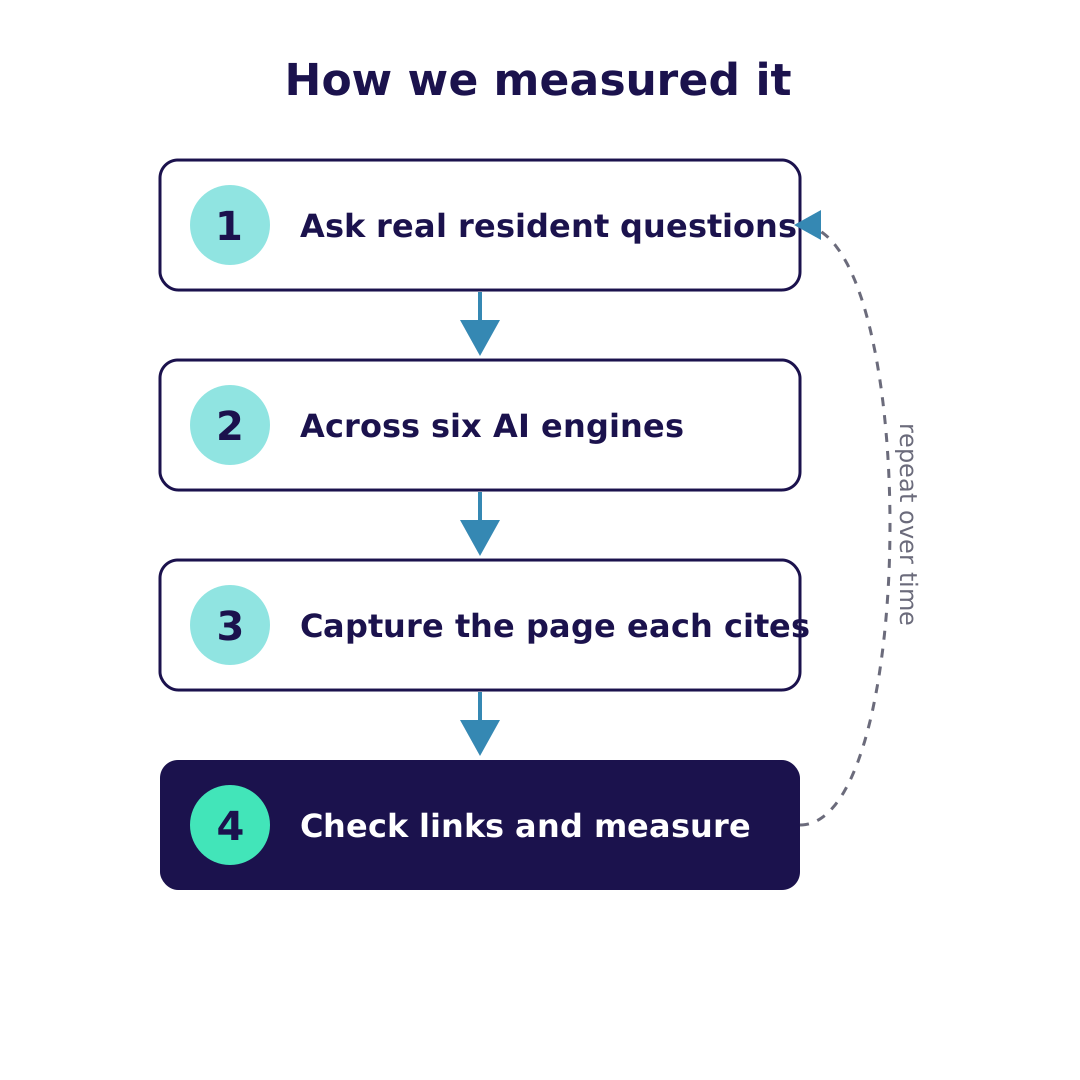
The mechanism is a loop, not a one-off audit. Each resident question is held constant so a later check is comparable to an earlier one, and for every answer we record not just whether the council is mentioned but which page the assistant points to and whether that page still works.
Built the library from real resident questions
Drawn from the council's own search data, so the questions we test are the ones residents actually ask, with how each AI assistant answered and which page it cited.
Turned it into a score the team can track
A repeatable scoring method the council can apply to any page, so "is this page clear to AI?" becomes a number to move.
Worked the first pages through together
Page-level recommendations, with the first cluster done as worked examples, so the team could see the method in action before running it alone.
Re-measured to keep the loop live
Confirming the approach and surfacing the next priority, rather than ending at a report.
The council took this and made it their own: the content team built custom AI assistants to restructure and fact-check a page, adapted the scoring to a ten-point scale with a breakdown, and now test each page's before-and-after across several assistants. What keeps working is the plain approach: clear question-shaped headings, short sections and direct answers. That helps a resident read the page, and it helps an AI read it too.
The council lifts its own scores, and the measurement finds the next fix
The council is no longer dependent on an agency to keep up with AI search. It runs its own measure-and-improve loop, and the first pages through it show the method works.
9.2
Average AI-readiness score for the first cluster of pages, up from 7.9 on the council's own ten-point rubric, with every page in the set improving.
In-house
The council runs the measure-and-improve loop itself now, testing each page's before-and-after across several AI assistants.
1 page
The next fix the measurement surfaced: one clear, canonical page per task. Most "broken" links turned out to be addresses the AI invented, not pages the council had lost.
The measurement also surfaced the next fix. When we checked every council page the assistants cite, most of the "broken" links turned out to be paths the AI had invented, not pages the council had lost: the same rates page guessed under a dozen plausible addresses. So the job is not chasing dead links. It is making one real page per task the clear, canonical one, which the council's page rebuilds are already doing.
A practice, not a report
For public-service content, it is no longer only about whether a resident can find the page. It is whether an AI can read it and answer correctly. The same plain edits help both. And a method the council can run itself is worth more than a one-off audit: it keeps improving pages over time, and it keeps up as the AI models change.
Ready to scale your marketing?
Let's grow your business and reach your digital marketing goals. Let's do this together.
Book a Free Strategy Call