
Women's Refuge
Turning donors into fundraisers
Website Development · Marketing Automation (Email) · Paid Media (Meta)
September 2026
Every year, Women's Refuge runs a Winter Appeal via its well-known Safe Night website, which now has a solid base of donors and recurring donors. This time, they wanted to try something different and see if they could leverage their supporters to raise money on their behalf. The Winter Appeal had to grow anyway, without a matching increase in paid media. Together, we built and tested a campaign where people could sign up for an activity challenge and raise sponsorship from their own networks, which recruited 600 fundraisers and roughly doubled appeal donations year on year.
A second way to give, built and proven in a single appeal window
+104%
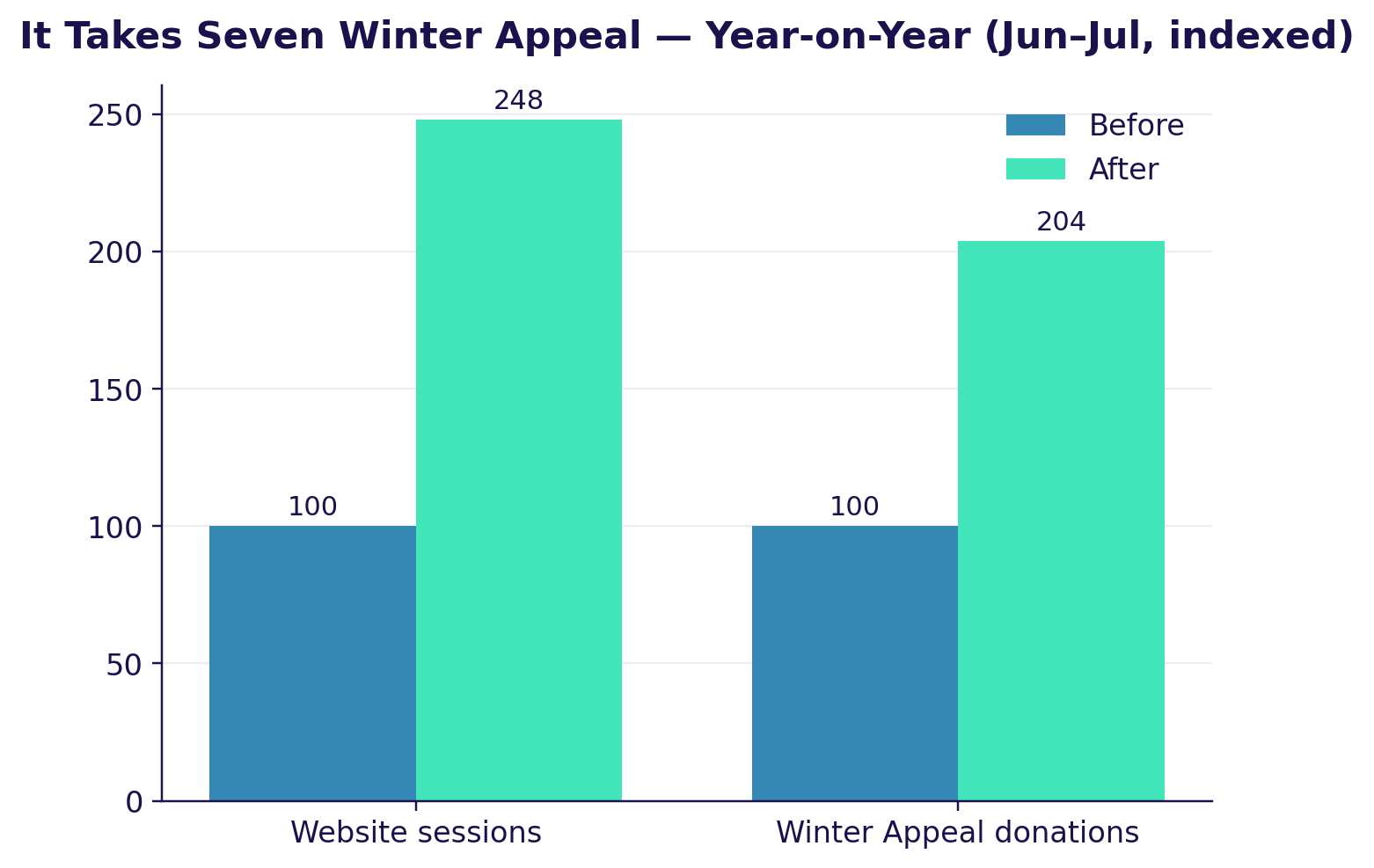
Winter Appeal donations, June and July, year on year
+148%
Website sessions to the campaign, June and July, year on year
600
People signed up to fundraise across New Zealand
Aotearoa's largest organisation supporting women and children
Women's Refuge is Aotearoa's largest nationwide organisation supporting women and children experiencing family violence. Its Safe Night campaign invites New Zealanders to gift nights of safe accommodation through its website, so online giving is central to its work.


One way to give, and no history to read
Safe Night is Women's Refuge's best-known website, supporting people escaping family violence. Until this appeal, there was 1 way to give: a direct donation, either a single gift or a regular one.
That worked, and it capped growth at how many people the charity could reach itself. Every donor had to find Safe Night first.
For an annual Winter Appeal that has to grow each year without a matching increase in paid media, that ceiling was the problem to solve. The limit sat in the number of people the charity could reach, so that is where the work went.
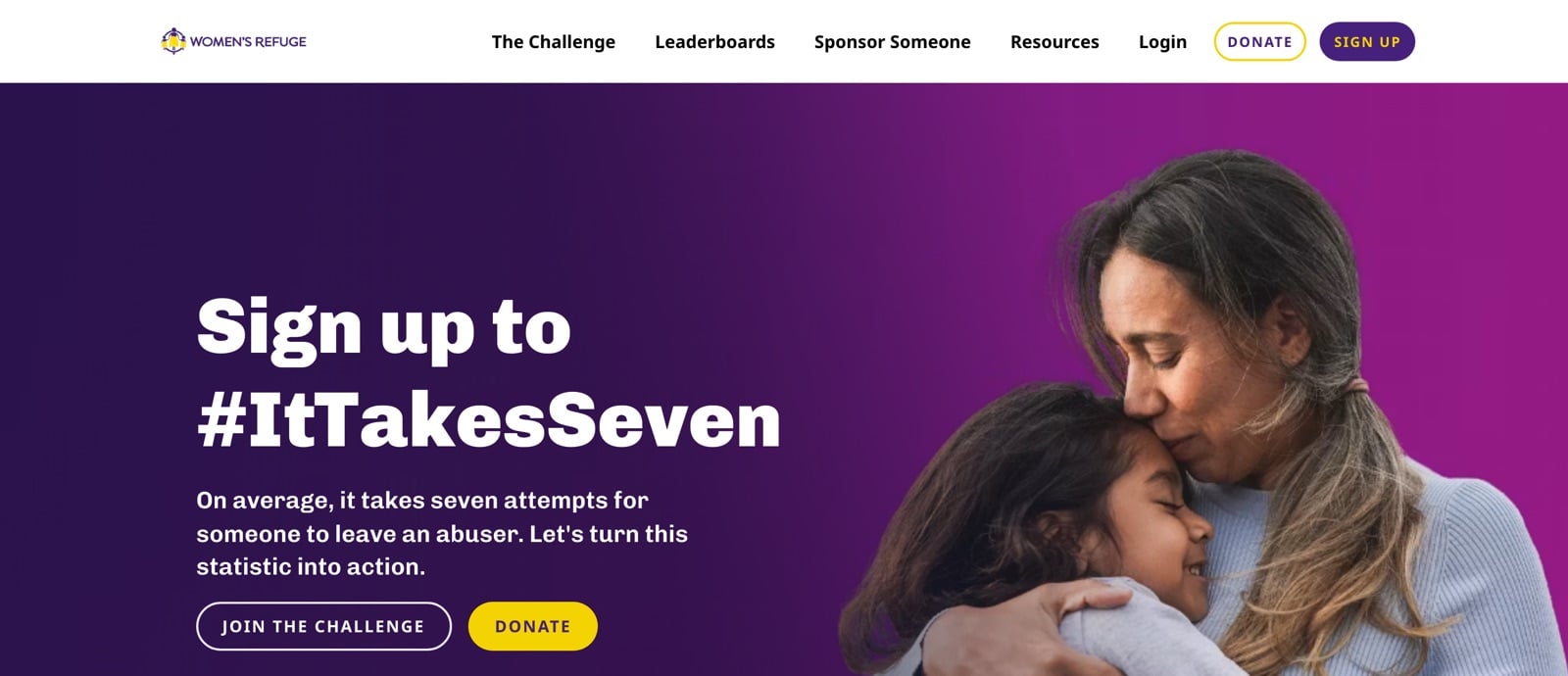
The appeal Women's Refuge wanted to build was a campaign named 'It Takes Seven', named for the fact that it takes a woman experiencing family violence an average of 7 attempts to leave. Supporters would sign up to a physical challenge and ask their own networks to sponsor them, so each one becomes a small fundraising channel.
Women's Refuge had never run a campaign of this kind, so there was no record of how many supporters would take it up, which channel would recruit them, or what a fundraiser does once signed up.
The campaign was also launching on a new domain with no traffic history and no social proof. Every visitor arriving for the first time had to sort themselves into 1 of 3 paths on a single visit: sign up to fundraise, sponsor a friend or donate. The appeal ran to a fixed calendar window, so there was no room for a slow first month.
Key challenges
No existing way for supporters to fundraise on the charity's behalf
Growth was capped at what the charity could reach directly.
No history to read
This was Women's Refuge's first campaign of this kind, and Data Story's first build on Raisely, so we could not assume how many people would join or what it would cost to recruit them.
A new campaign domain with no traffic history
Every visitor arriving for the first time had to choose between 3 different paths in a single visit.
A fixed appeal window
No allowance for a slow start before results mattered.
An existing donor database to activate
Plus a new audience of physically active people to reach and keep engaged across a challenge running for a month.
Set it up so we could tell whether it worked
Women's Refuge had never run a campaign like this. Nobody knew whether supporters would fundraise, or what it would cost to sign them up. That made it a test, and a test is only worth running if you can read the result.
So we built it as its own website. If we had bolted it onto the existing donation pages, its visitors and its donations would have been mixed in with the giving that was already happening, and nobody could have said what the new idea did on its own.
We didn't build that website from scratch. We used one of Raisely's ready-made fundraising templates, so sign-ups, emails, activity tracking and fundraiser pages already worked. That let us spend the time on testing instead. We walked every path a visitor could take, start to finish, before it went live.
Build it as its own website
A standalone campaign site on a proven Raisely template, separate from the existing donation flow, so the new campaign could be measured without disturbing the donation pages already working.
Test every path before launch
Sign up, donation, sponsoring a friend and activity tracking, all tested end to end while the campaign was still in Raisely's test mode.
Recruit through the people who already give
A series of 6 emails to the existing donor base, written to recruit the first fundraisers early and keep reminding the rest as momentum built.
Split paid social budget into 2 goals
One Facebook campaign in June to recruit fundraisers, a second in July to drive donations.
A second way to give, adopted at community scale
The campaign recruited 600 people to fundraise on Women's Refuge's behalf, and Winter Appeal donations roughly doubled year on year.
600
People signed up to fundraise, across 88 teams and 3 organisations. Whole teams and workplaces joined alongside individuals.
29,147 km
Activity logged by participants across running, cycling and kayaking, with Strava connected for automatic tracking. Fundraisers stayed with the challenge after signing up.
+104%
Winter Appeal donations, June and July year on year, alongside a 148% rise in visits to the campaign site. More people arriving, and more of them giving.
Splitting Facebook in 2 made its contribution readable. The June campaign recruited fundraisers at low cost. The July campaign, judged on its own goal, returned around 7.5 times what was spent on it.
The June spend kept paying out long after the ads stopped, because each fundraiser it brought in went on to ask their own network for sponsorship, using the social posts, posters and QR codes we supplied.
The emails ran at 35 to 45% open rates across all 6 sends, above typical nonprofit benchmarks. Email did the most work in this campaign, turning existing donors into fundraisers with networks of their own.
What this campaign shows
A fundraising campaign can grow without a bigger media budget
What it needs is a way to turn supporters into recruiters, each with a network of their own to reach.
On a fixed deadline, proven software tested thoroughly beats a custom build rushed to launch
Reliability at launch matters more than originality.
Give paid media one job per campaign
Recruiting fundraisers and driving donations are different goals. Splitting them let us judge each campaign against the outcome it bought.
When supporters fundraise for you, email does the most work
It is what turns existing donors into fundraisers.
A second way to give, and a record of what it takes to run it
Safe Night had 1 way to give and no evidence that a second would work. We left the first one running and built the second as a contained test: its own website, on proven software, checked before launch, with email recruiting the first fundraisers and paid social split into 2 separate jobs.
Inside a single appeal window, 600 supporters signed up to fundraise, participants logged 29,147 km, and Winter Appeal donations roughly doubled year on year. Women's Refuge now has a second way for people to give, and knows what it costs to recruit the people who drive it.
The It Takes Seven campaign gave our supporters a fresh, engaging initiative that was easy to understand, participate in, and share with others. This simplicity helped create a strong sense of involvement and gave our existing supporters a clear way to become advocates for the campaign themselves. By encouraging people to share the initiative through their own networks, we were able to extend our reach beyond our existing audience and introduce the campaign to new supporters, helping to build greater awareness and engagement around our work.
Using our existing CRM/CMS infrastructure was extremely effective and efficient. Rather than having to develop an entirely new website from scratch, we were able to use the functionality already available within our existing system to create what was, in practice, a new website and user experience. This significantly reduced the amount of development time and resource required, while also avoiding many of the costs associated with building, testing, and maintaining a separate platform. It allowed us to move quickly from concept to delivery while still creating a tailored digital experience that supported the campaign's objectives.
Susan Barker, Communications, Marketing and Fundraising Manager, Women's Refuge
Ready to scale your marketing?
Let's grow your business and reach your digital marketing goals. Let's do this together.
Book a Free Strategy CallMore results
All results →
Data Story
We sold GEO before our own site said so. Here is what happened.
31 August 2026
See results
West Coast Wilderness Railway
Proving a redesign before a line of it is built
28 July 2026
See results
Data Story
We rebuilt our website with AI, moved faster, and held our search visibility.
8 July 2026
See results