
AI visibility is a metric. What you do with it is strategy.
We do not start with what AI visibility tools can measure. We start with the commercial questions you are trying to answer, then use AI search data alongside other evidence to help you make better decisions.
A visibility score only tells part of the story.
Plenty of tools can tell you how often AI assistants recommend your business, which competitors appear alongside you, and whether your visibility is improving. That is useful information. It does not tell you what to do next.
Imagine your visibility increases by 10%. Are more customers considering your business? Are you appearing in the markets you are trying to grow? Are customers finding you directly, or being directed towards resellers who charge commission?
Or has the score moved without anything changing for the business? A visibility dashboard cannot answer those questions on its own.
The problem is not the metric. It is starting with the metric before the business question.
Start with the decision. Work backwards to the data.
Every business has commercial questions it is trying to answer. Where should we invest to grow? Why are customers choosing competitors? What is stopping more people from booking? We work backwards from those questions to the evidence that would inform a better decision.
Start with the commercial question
Before choosing prompts or building a dashboard, we establish what the business is trying to understand or change.
Identify and investigate the evidence
What the AI answers could tell us, which other sources matter, and what would count as evidence. Every metric carries a defined purpose, denominator and measurement period.
Decide what deserves attention
The findings might support a change in positioning, content, distribution or market investment. They might also show the current approach is working, or that another problem matters more.
A tourism operator wanted to know where its next growth opportunity would come from.
The business sells across several international markets, directly and through trade partners. One of those markets is one it is actively working to enter. We investigated how often AI assistants recommended its category of experience in each.
79%
Home market
55%
Market two
40%
Market three
Share of eligible AI answers recommending the category, by market.
Those markets are not at the same stage, and that is what makes the comparison useful. In the established market the figure sits alongside years of booking data. In the market the business is working to enter, that history does not exist yet.
In a new market, AI answers give us an early view of whether the category is being recommended to potential customers, even before the business has booking history to analyse.
That does not tell us whether those recommendations will translate into demand. But it gives us something to investigate alongside awareness, search behaviour and the development of distribution partnerships.
From measurement to action
Kāpiti Coast District Council wanted to know what AI assistants were telling residents who asked about rates, dogs on beaches or flood risk. We built the question library from the council’s own search data, then turned it into a repeatable score its content team could apply to any page.
They acted on it. The team restructured the first cluster of high-traffic pages and re-measured: the average AI-readiness score moved from 7.9 to 9.2 on their own ten-point rubric, with every page in the set improving.
The measurement then surfaced the next fix. Most of the apparently broken links the assistants cited turned out to be addresses the AI had invented rather than pages the council had lost, so the job was making one canonical page per task instead of chasing dead links. The council runs that loop in-house now, across several assistants.
What turns AI measurement into a decision?
The tourism operator’s findings opened up a new line of investigation. Kāpiti Coast District Council used its findings to improve pages and measure the results.
Both started with a business question, not a visibility score.
That’s how we approach AI measurement. We use the evidence to identify what needs to change, what needs further investigation, and what is already working.
Sometimes the best recommendation is to focus somewhere other than GEO.
The point isn’t to improve a metric. It’s to make a better business decision.
What we’re learning about AI search
SEO & GEO
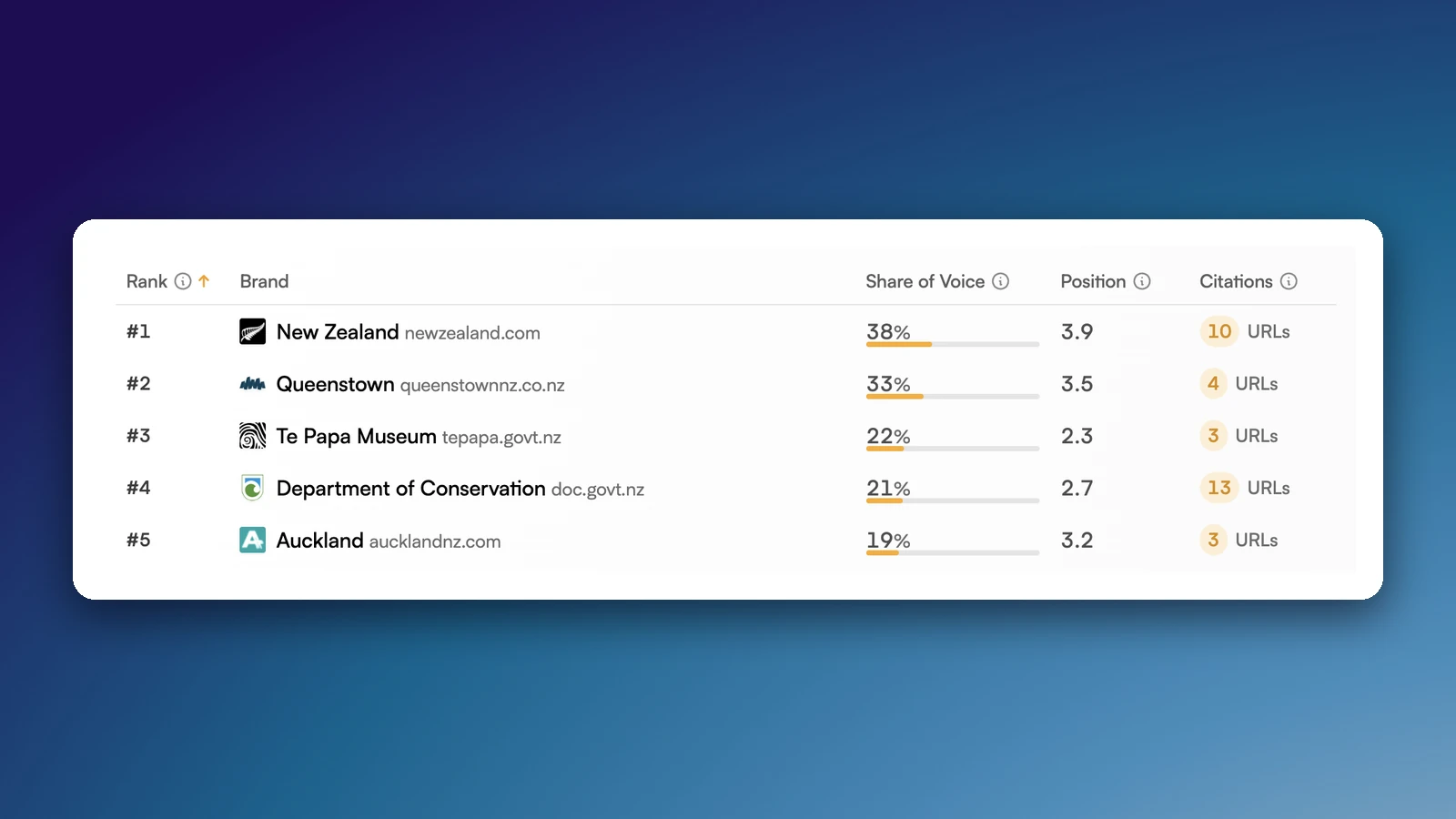
Mention, share of voice, citation, source share: the GEO metrics that matter, and why they're not the same thing
30 June 2026
A GEO report scores you on two layers, named and sourced, and asks two kinds of question, did it happen and how much was yours. Four numbers, easy to confuse, and aiming at the wrong one can burn a quarter.
Read article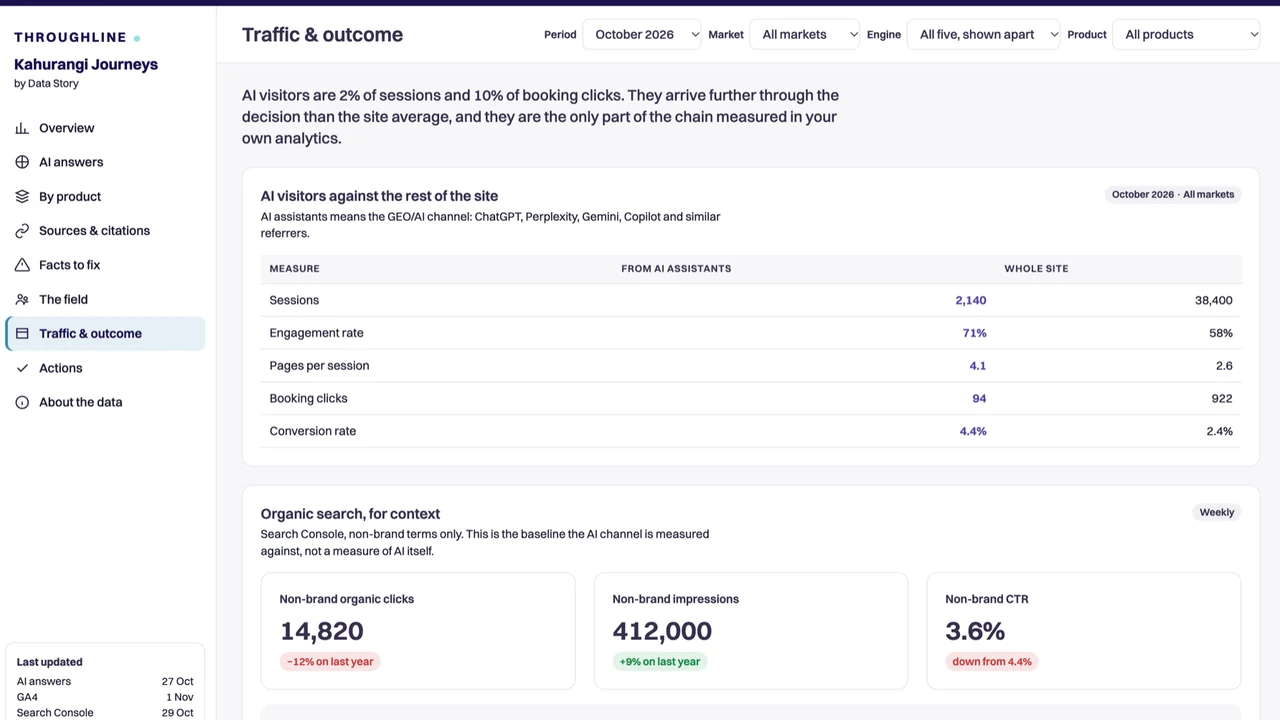
SEO & GEO
Organic traffic is falling. So why aren't bookings?
2 November 2026
Organic search clicks are disappearing while bookings and revenue hold steady. What tracking 2,700 AI search prompts a week across 16 brands is teaching us about where customers now make their decisions.
Read article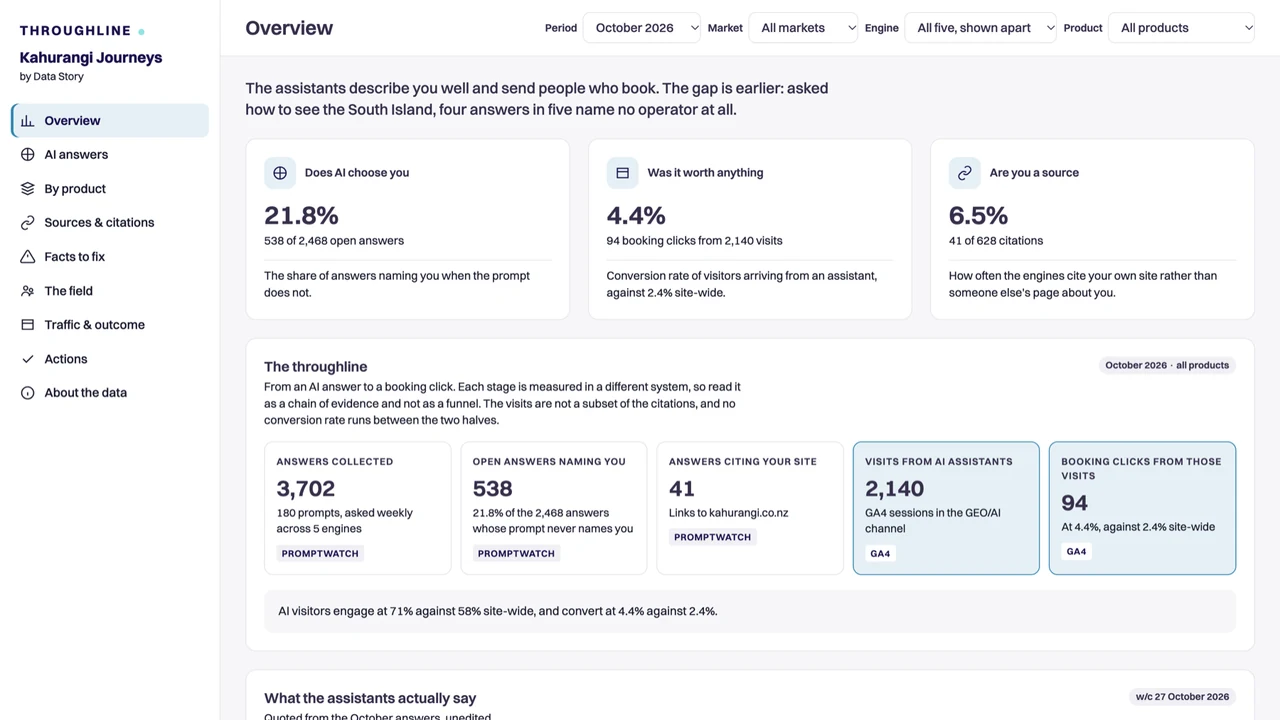
SEO & GEO
We analysed 150,421 AI answers. Here's what we learned about AI search.
2 November 2026
Six findings from 150,421 AI answers across 19 tracking projects: why small prompt libraries mislead, why brands are stable but citations churn, and what that means for your GEO strategy.
Read articleFrequently asked questions
See how we turn data into decisions




Not sure what your AI visibility data is telling you?
We will look at the commercial questions you are trying to answer, what your current reporting can tell you, and where the evidence is missing.