
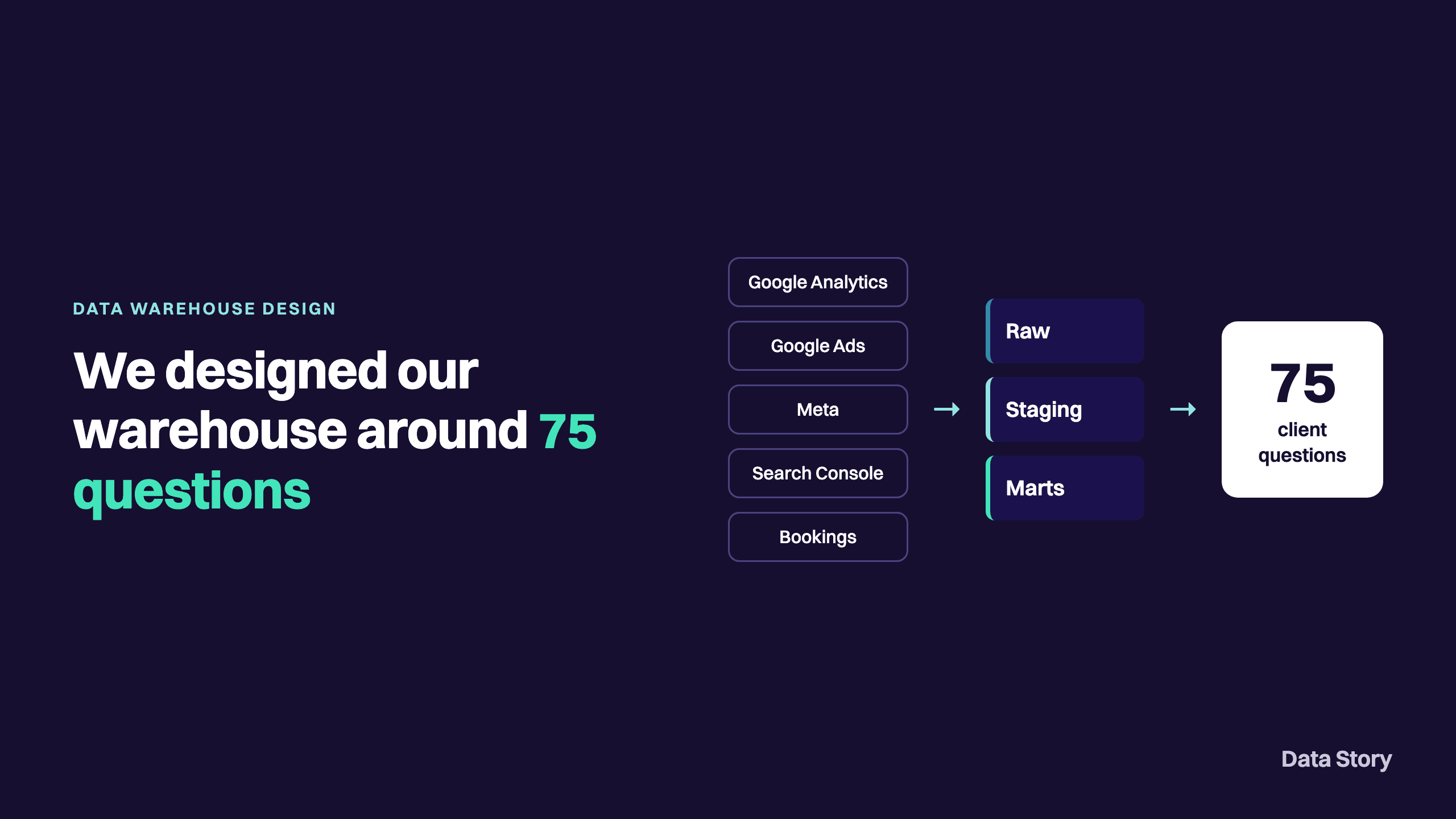
Before you spend more on collecting marketing data, decide which questions you need it to answer. In early November 2026, we held about 560 GB of client data, but only about 4 GB was in tables ready to answer our marketing questions. Our priority was to make better use of the data we already held.
Good marketing results depend on answering questions well and asking the right questions. With AI increasingly doing the work of setting up measurement and producing reports, what clients still find difficult to get for themselves is answers they can trust about what caused their results and what to do next. We wanted to organise our data around the decisions our clients needed to make.
On 5 November, we wrote down 75 questions that our clients, their marketing managers and their CEOs ask about marketing. These included "Will we hit the annual target?", "Which campaigns make money, and which only look good in the platform?", "How many visits does it take before someone books?" and "Is the change ours, or the whole market's?" Each question relates to a decision about where to focus your marketing or how to spend your budget.
We arranged the questions in the order a report is read: overall performance, spend, the stages of the customer journey (Want, Find, Consider, Buy, Rebuy, Refer), then channels, the market and our own work. We assigned the same customer journey stages to the questions and the metrics needed to answer them. This makes it easier to identify what you need to measure at each stage of your customer's journey.
Checking the questions against the data we held helped us establish what was missing. Most of the gaps fell into 3 areas: which marketing spend drives bookings and what would have happened anyway, the value and behaviour of customers, and how a business is performing relative to its market. Knowing where those gaps are helps you decide where further investment in measurement would be useful.
We used the questions to prioritise the data we ask clients for. Booking data alone would help us answer 13 questions. You can use the same approach to assess which sources of data would be most useful to your business.
We also needed to agree on what each metric meant before combining data from different platforms. Your booking system and Google Analytics can report different booking figures because bookings made over the phone or through an agent never touch your website. Keeping one written definition for each metric helps you understand which figure to use when answering a question.
Before building the data warehouse, we held each client's marketing data across at least 4 platforms: Google Analytics 4, Google Ads, Meta and Search Console. Investigating a new question could mean rebuilding spreadsheets, so some useful questions were never investigated. Bringing the data together reduces the amount of preparation needed when you want to investigate something new.
Each client now has their own Google BigQuery project, which we update every night. We are building each client's data warehouse around these 75 questions, so the Data Story System is set up to answer them, plus any questions specific to that client.
What data should you collect?
A table that answers no question costs money and has no reader. By establishing the questions and the metrics needed to answer them first, you have a basis for deciding which data is worth collecting and maintaining.
Try this now
Open the Campaigns report in Google Ads and check whether you have enough information to determine which campaigns make your business money. You should be able to identify the sales and cost data you need, where it is held and whether you can connect it to your campaign spend. If you cannot, you have identified a gap to address in your marketing data.
Start with what you need to know before deciding what you need to collect.
Work with us
If you need better data to decide where to focus your marketing, we can help you build a data warehouse around those decisions. Book a free strategy call.

Written by
Arthur Davey
Performance and Insights Lead
Arthur heads up performance and analytics at Data Story. He specialises in GA4 implementation, custom dashboards, and extracting the insights that drive measurable marketing improvements. Arthur is the team's resident data detective — he finds the signal in the noise.
LinkedInRelated articles
Analytics
A drop in website sessions can be a measurement problem
26 November 2026
A visitor attraction's sessions fell 74% while its Google Search clicks rose. Check a second source before you change your marketing.
Read article
Analytics
Geo incrementality testing: what happens when you turn your ads off?
13 November 2026
To find out whether your advertising is working, you may have to switch it off. Here's what a geo incrementality test can reveal, and what to do with the answer.
Read article
Paid Media
Consistent campaign names let you compare every ad platform at once
4 November 2026
The same creative runs on Meta, Google and TikTok, but each account reports on its own. A shared naming convention gives every campaign, ad set and ad common fields, so you can compare a creative, a market or all your awareness campaigns across platforms.
Read article