

Most annual marketing plans are a stack of channel targets. Grow paid media. Improve SEO. Run a CRO programme. Each line owns a number, each number rolls up to revenue, and the plan looks complete. What it leaves out is the customer. A plan organised by channel can hit every channel target and still miss the largest source of growth already in the business: the customer who has bought once and could buy across several parts of the company.
Start the plan with the customer
Before you set a single target, map how a customer moves through the business. We map it around the journey stages we plan and measure against. The map earns its value after the first Book, the part a channel plan rarely models.
A winery example
A Central Otago winery with four customer-facing businesses: a restaurant, a wine club, a cellar door, and online wine sales. Treated as four separate revenue lines, the business gets four plans. Seen as one customer who moves between them, the opportunities connect. Someone who books the restaurant is a strong candidate for the wine club. A wine club member visiting Queenstown is a candidate for a cellar door booking. An online wine buyer in Auckland has never set foot in the restaurant but would, on the right trip.
The audience pathway map
For each entry point, you record where the customer first found out about you, how they arrived, and the action they took. Then the next step the business wants, and the tactic that nudges it.
One row from the map
That is one customer, one action, one named next step, and one tactic to move them. Do it for every entry point and the cross-sell structure of the whole business appears on one page. Cellar door feeds the wine club. The wine club feeds the restaurant. The restaurant feeds online sales. Online sales feed the wine club. Every service both attracts new customers and leads existing ones to the next service.
What the map changes about your goals
Your annual goals widen from acquisition targets to the moves that compound: getting an existing customer to buy a second service, come back, and refer. In our annual planning that sits under the Retention and Repeat priority, and the journey map shows how hard to back it. For a business with four services and a database in the tens of thousands, the map usually shows this is worth backing hard, because the candidates for the second purchase already exist and already trust the brand.
Cost to acquire versus cost to grow
New customer acquisition stays of equal importance. The map surfaces a question most channel plans skip: what does it cost to acquire a new customer, versus what does it cost to grow one you already have? On the winery example plan, every tactic carries both figures. Acquisition tactics, paid media to a cold audience, are generally higher cost. Cross-sell and retention tactics, an email to a wine club member, a QR code at the table, a referral incentive, are generally lower. Growth from a customer who already knows you is the segment most plans overlook.
That decides how you scale. When cost per new customer is high and cost to grow an existing one is low, the plan that scales fastest leans on the database before the ad account. You still acquire, knowing each new customer is worth more once the cross-sell structure behind them works, which makes that spend easier to justify. Lifetime value puts a number on it.
Lifetime value of one customer
A single first purchase, nurtured across the business, compounds into far more over a year. The figures below are illustrative.
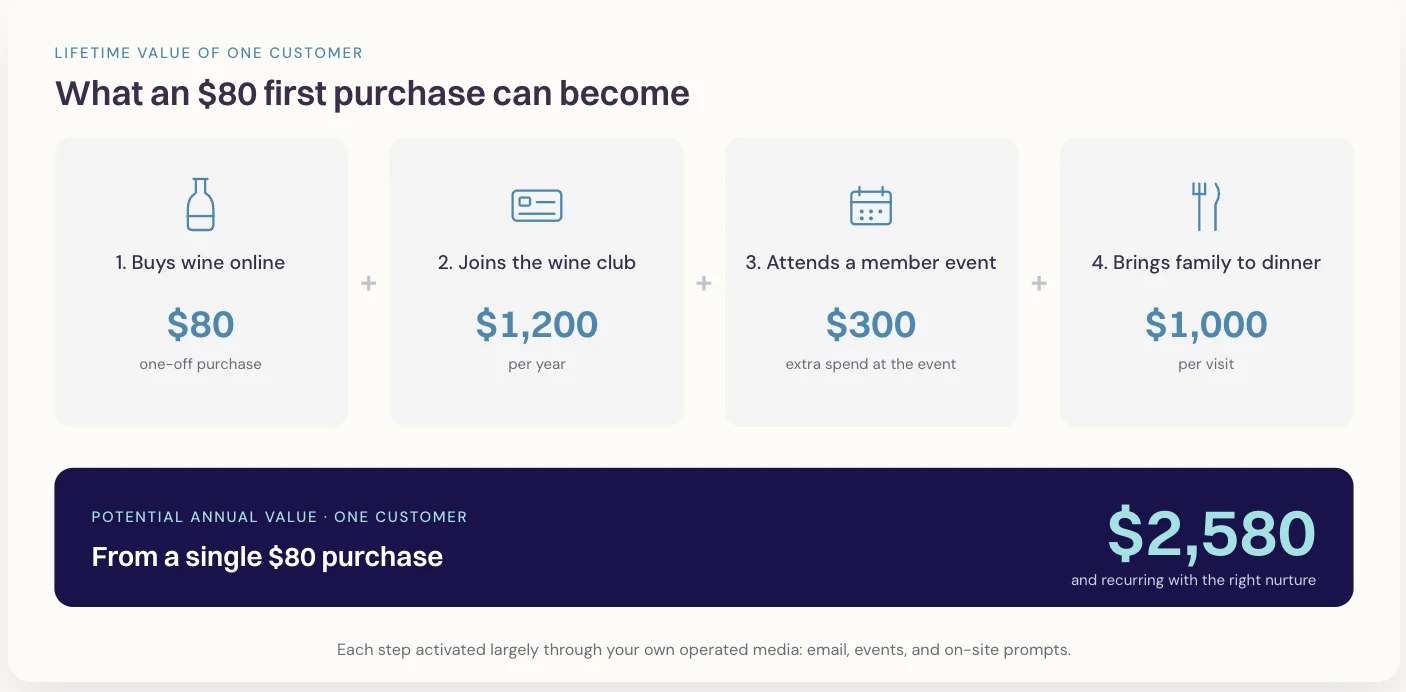
The question a journey goal asks
A goal set against the journey asks where the customer goes next, and what it is worth to take them there. A goal set against a channel asks how to get more from that channel. The journey question is harder, and it is the one that surfaces the growth already inside the business.
What to take away
Want your annual plan built around the customer journey?
That's where we start. We'll map the journey, size the cross-sell already inside your database, and turn it into an annual plan you can measure.
Book a Free Strategy Call
Written by
Samantha Tokay
Digital Marketing Specialist
Samantha is a digital marketing specialist at Data Story, focused on paid media strategy and performance across Google Ads and Meta. She helps clients turn ad spend into measurable growth by tying budgets to clear goals and real source-of-truth data.
LinkedInRelated articles
Customer Journey
You can't do good marketing with AI until your data is organised for it
16 July 2026
Read article
Destination and Experience
The tourism journey is too long to measure by gut
16 July 2026
Read article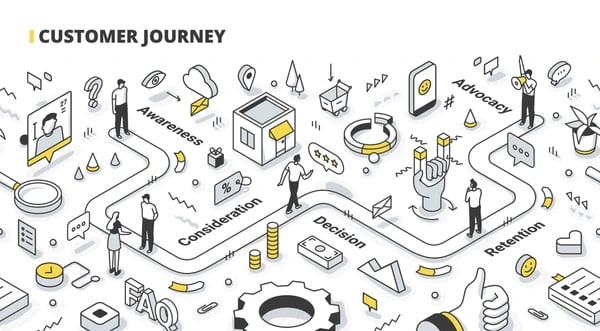
Customer Journey
Understanding your customer journey
26 March 2025
Purchasing is a decision that happens over time. By breaking that journey into key moments — and measuring them — you give your marketing the focus it needs to actually move the needle.
Read article