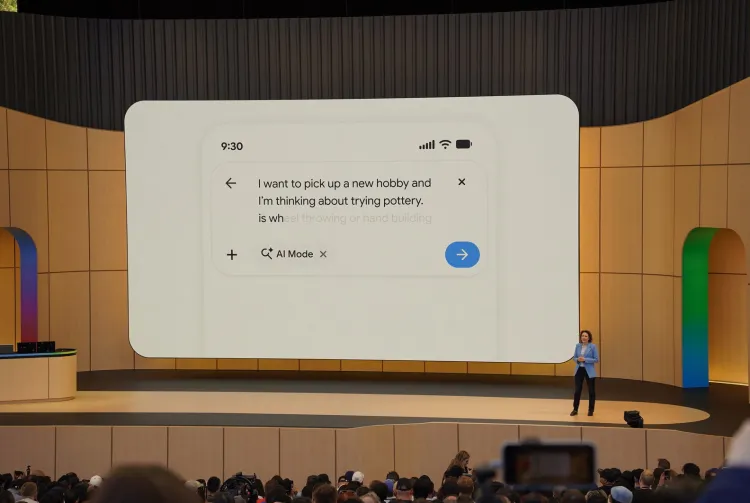
I didn't watch the Google I/O 2026 keynote live, but I've been following it closely since. The Verge's framing has stuck with me:
Last year Google's future was googling for you. This year, Google wants to do everything for you, all from the search box.
This is a useful description of where search is actually heading, and it has real implications for how marketing leaders should be thinking about visibility, content, and the work their teams are doing right now.
Here's what I've been mulling over.
What actually changed
Six things from I/O 2026 are worth paying attention to, even if you only have ten minutes.
- The Search box itself. Google called this the biggest upgrade in over 25 years. It accepts text, images, files and videos as inputs in a single query, expands dynamically as you write longer questions, and offers AI-powered suggestions that "go beyond autocomplete."
- Information agents. Background agents that run 24/7 on behalf of a user. You describe what you want to track (apartment listings, sneaker collabs, sector developments) and the agent monitors the open web plus Google's real-time data, then sends synthesised updates when something changes. Coming this summer.
- Generative UI in Search. For complex questions, Search now builds a custom interface on the fly (interactive visuals and widgets, dynamic layouts) assembled in real time from Gemini 3.5 Flash's coding capabilities. Free to everyone, this summer.
- Mini-apps in Search. For ongoing tasks like wedding planning or managing a home move, Search will code a persistent dashboard or tracker you keep coming back to, pulling in live data each time.
- Personal Intelligence expansion. Search can now read a user's Gmail, Photos and Calendar to condition answers on personal context. Google expanded Personal Intelligence to users worldwide last week, in a Gemini app now available across more than 230 countries and over 70 languages.
- Universal Cart and agentic commerce. A single cart that follows the user across Search, Gemini, YouTube and Gmail. The transaction layer is being pulled into Search itself.
Worth saying plainly: every line above is Google's own framing from the keynote. What these features do in practice, and how people actually use them, is something we'll only know by watching.
That's the bulk of it. Six things, each one chipping away at a different assumption marketers have made about how customers find, evaluate, and choose us.
Why this breaks the old playbook
SEO assumed a human typed a query, scanned a list of links, and clicked through to a website. The website was the destination.
Generative Engine Optimisation (GEO), which is what most of us have been adapting to over the past two years, assumed that AI tools would answer the question, citing sources. The job became being one of those cited sources, with accurate information, good framing, and visibility across engines.
Both of those still matter. SEO hasn't gone away. GEO is increasingly essential. But neither of them describes what's actually happening now.
What's happening now is that the user is no longer running a single query. An agent is running thousands of queries in the background on their behalf, indefinitely. Search isn't returning a page of links or even a paragraph of summary. It's building a bespoke interface, a mini-app, a custom dashboard for that specific person and that specific moment. The answer is being conditioned on the user's own data. And in many cases, the transaction is happening inside Search, with the agent completing the checkout.
That's not a search results page. That's a layer that sits between your organisation and your customer, doing more of the work each year.
The questions marketing leaders should be asking
I don't have neat answers to most of these. I'm not sure anyone does yet. But the search box is going to keep changing whether or not we're paying attention, and the questions are how you stay in front of it rather than behind it.
- When an information agent is monitoring our sector 24/7 on behalf of a prospect, what would put us in the agent's update?
Picture a traveller who sets an agent to track things to do in Queenstown and leaves it running for the months before their winter trip. The lodges and tour operators that surface in their updates will not be the ones with the best website, but the ones the agent keeps finding something new to say about. Frequency of publishing matters more in an agent-monitored world than in a human-search world. So does the freshness signal on our content. So does whether we're producing the kind of structured, newsworthy updates an agent would actually surface, or whether our content is the sort of thing that only gets found when someone goes looking.
- When Search builds a generative UI to answer a question in our category, are we a component or a citation?
If Search is assembling an interactive comparison table on the fly, the organisations whose data is structured, machine-readable and authoritative get pulled in as part of the interface. Everyone else becomes a link at the bottom, if that. The implication is that structured data and schema aren't a technical SEO checklist any more: they're how you participate in the answer itself.
- When Personal Intelligence conditions every answer on the user's inbox and calendar, what does "relevance" even mean?
Ranking used to be about authority: who is the most credible source on this topic. Increasingly it's about relevance to this person, right now, conditioned on data we don't see and can't influence. That's a meaningful shift. It pushes us towards content that is specific, contextual, and useful for a clearly-defined situation, not generic thought-leadership written for "the market."
- When an agent can compare prices, add to a cart and check out on a customer's behalf, are we a business it can actually transact with?
This is a concrete operational question. Is our product and availability data structured, accurate and machine-readable? Are our prices and categories clear enough for an agent to act on without a human in the loop? Can an AI agent complete a purchase or a booking with us, or do we still require a human-shaped journey? For retail and service businesses especially, this is going to matter quickly.
- When the search box does everything (research, comparison, booking, tracking, transacting), what is our role across that journey?
SEO optimised for the moment of search. GEO optimises for the moment of answer. But there are now multiple moments: the agent's standing query, the generative UI moment, the mini-app the user returns to, the moment of agentic transaction. Each is a place where we are either present or absent. And none of them are well-served by a content strategy built only around blog posts, this one included. A blog post is how a marketer thinks out loud. It is not how you show up inside an agent's standing query.
- And the uncomfortable one: if AI tools are getting "good enough" at answering questions about our category without sending users to our website, what is the website even for?
I'm not arguing it's nothing. I'm arguing that we should be deliberate about what it's for now, because "destination for organic search traffic" is a less complete answer every quarter.
Where GEO fits in all of this
GEO isn't the answer to those questions. But it's the foundation that lets you start working through them honestly.
You can't adapt to a moving landscape if you can't see where you stand in it today. The work we do at Data Story on Generative Engine Optimisation is, at its core, measurement work. We build a library of the questions people are actually likely to ask AI tools about your organisation, run them across the major engines, and score the answers for accuracy, completeness, framing, citation quality, and whether your content is being used as a source at all.
That gives you a benchmark. It tells you which engines are getting your story right, which are missing you entirely, and which third-party sources they're relying on instead of you. From there, the action plan is concrete: the content gaps to fill, the structured data to add, the authoritative external sources to address.
But the deeper value of doing this work, and the reason I think marketing leaders should be doing it now rather than waiting, is that it builds the habit of measuring how AI tools represent you. Because that representation is going to keep changing. The Search box this year does things it didn't do last year, and it'll do different things again next year. The organisations that thrive aren't the ones who get GEO "right" once. They're the ones who build a measurement and adaptation loop they can keep running as the landscape shifts.
Final Note
The instinct, when faced with a change this big, is to look for the new playbook. I'd resist that. We're in the early innings of an architectural shift in how people get answers, and anyone selling you a definitive playbook is selling you certainty they don't have.
What we can do is sharpen the questions, measure honestly, and build the kind of adaptive practice that doesn't require us to predict the future to keep up with it.
The search box is going to keep getting bigger, smarter and more autonomous. The job isn't to optimise for the search box of 2026. It's to build an organisation that can keep showing up as the answer, whatever the box becomes next.